3D Digital Asset Management vs. DAM: Why You Need a Purpose-Built Platform
3D Digital Asset Management vs. DAM: Why You Need a Purpose-Built Platform
3D DAM Asset Operations
11 min
Technical blogger
Aisha Rahman
Updated:
Posted:
Quick Summary
The real difference between 3D Digital Asset Management vs DAM beyond simple storage
Why traditional DAM systems often become “file lockers” for 3D and where that breaks at scale
The five pillars of a purpose-built 3D DAM platform, from CAD ingestion to publishing
A decision framework to choose the right approach for your organization
How Vivid 3D fits into this as a Visual Data Platform, without forcing you to rebuild your stack
Why this comparison exists at all
Traditional DAM systems were designed for 2D assets: images, documents, video, and marketing collateral. That world is mostly about organization, permissions, and distribution.
3D content introduces a different operational reality. A 3D asset is not just a file you download. It is a structured object with geometry, materials, textures, variants, performance budgets, and multiple downstream targets. It must be previewed interactively, reviewed by non-technical stakeholders, optimized for device constraints, and published in formats that match specific channels.
So the real question is not “Where do we store 3D files?”
The question is “How do we make 3D usable, repeatable, and scalable across teams and channels?”
That is exactly what a purpose-built 3D content management system is meant to solve.
Traditional DAM vs 3D DAM in practical terms
The fastest way to understand the gap is to look at what teams actually do after a model is created.
Area
Traditional DAM
Purpose-built 3D DAM platform
3D ingestion
Stores files, limited understanding of 3D structure
Ingests CAD and DCC assets and prepares them for downstream use
Preview
Static thumbnails or attachments
Interactive browser-based 3D preview and inspection
Optimization
External tools, manual processes
Automated 3D processing pipelines (LOD, decimation, baking, compression)
Metadata
Descriptive tags and basic properties
Technical 3D metadata (polycount, materials, UVs, rigs, LODs, readiness)
Collaboration
Comments on files or screenshots
Model-first review workflows with controlled approvals and feedback
Publishing
Download and distribute
Omnichannel 3D delivery with channel-specific variants
The five pillars of a modern 3D DAM platform
1) CAD file optimization and conversion to delivery formats
In many industries, the upstream source is CAD. CAD is precise and heavy by design. That precision is valuable for engineering and manufacturing, but it becomes expensive for web, mobile, and real-time workflows.
A 3D DAM platform should support CAD ingestion and standardize the conversion path into delivery formats such as GLB and USDZ. This removes the repeated manual work that tends to appear in every product update cycle.
2) Automated optimization that scales with catalog size
Optimization is where 3D programs either become sustainable or become a permanent staffing problem.
A scalable approach typically includes:
polygon count reduction and LOD generation
texture workflows (including baking where needed)
geometry compression for web delivery
consistent export profiles per channel
For web delivery in particular, mesh compression is not a “nice to have.” The KHR_draco_mesh_compression extension in the glTF ecosystem formalizes how Draco-compressed geometry is represented for glTF assets, which is why it appears so often in production pipelines.
3) Web-based 3D visualization and review
If review relies on static thumbnails, teams tend to approve what they cannot fully inspect. That increases revision cycles later, usually when changes are more expensive.
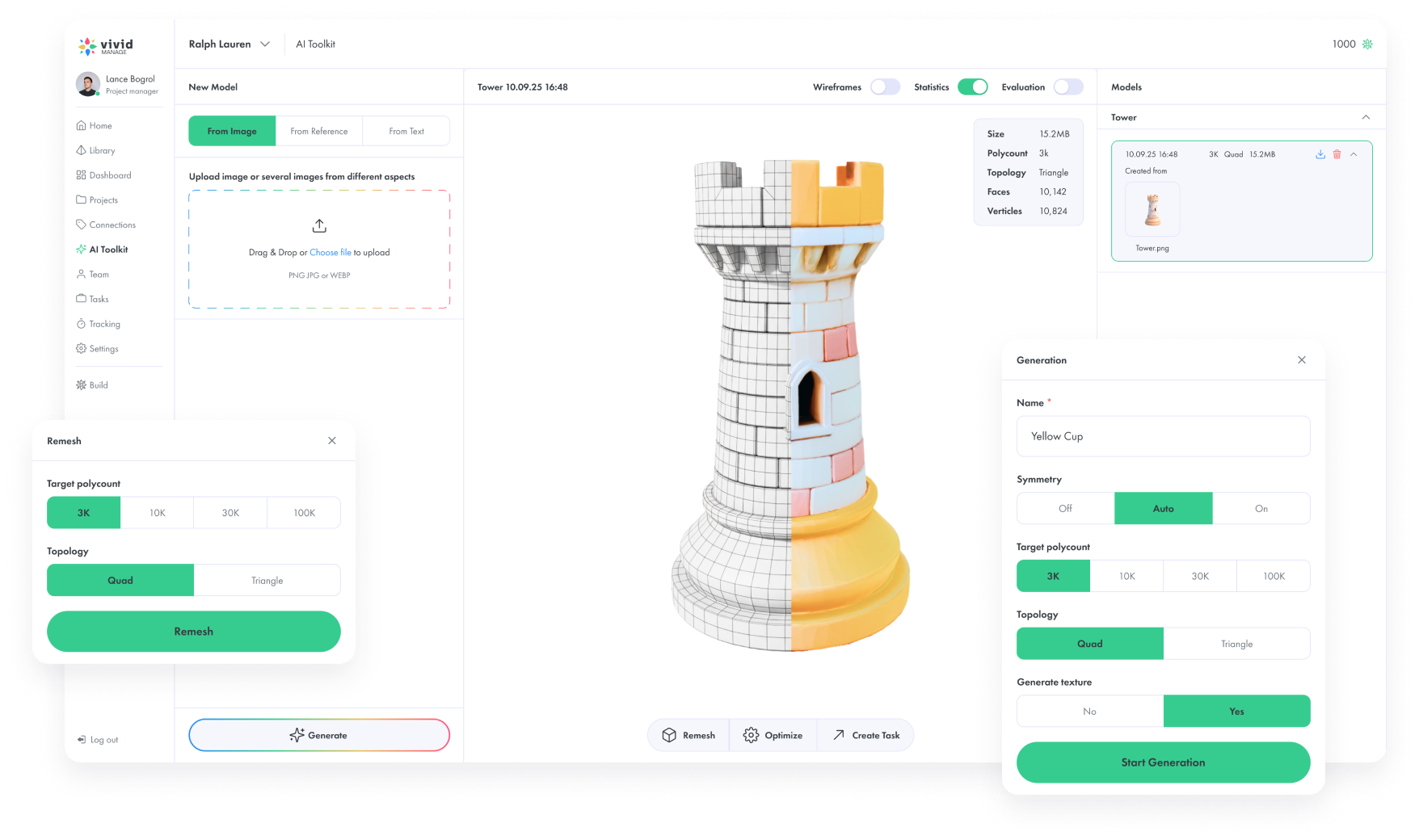
A 3D DAM should include web-based 3D visualization so stakeholders can inspect geometry, materials, and variants in a browser without specialized software. When the review surface is accessible, approvals become faster and quality becomes more consistent.
4) Technical 3D metadata indexing for search and governance
3D libraries grow quickly. Once you have hundreds or thousands of assets, the bottleneck shifts from “creating models” to “finding the correct version and trusting it.”
Technical indexing is the difference between:
“I think the asset exists somewhere” and
“Here is the web-ready version under the correct poly budget with approved materials”
A 3D DAM should index technical metadata such as polycount, material assignments, UV structure, rigging data, LOD availability, and compatibility tags. This enables operational search, lifecycle governance, and controlled publishing rules.
5) Omnichannel delivery for web, AR, XR, and engines
The same asset is expected to power multiple experiences:
eCommerce viewers
AR previews
configurators
sales tools
training and real-time applications
Two standards-driven realities matter here:
If you are building browser-based XR experiences, the WebXR Device API is the foundation for accessing VR and AR devices on the web.
If you are targeting Apple’s AR viewing flows, AR Quick Look is the native preview mechanism and comes with clear expectations around model packaging and viewing behavior.
A 3D DAM platform should manage format variants, publishing rules, and channel-specific constraints so teams do not reinvent delivery for every destination.
How to evaluate 3D asset management software
Category
What to verify
Why it matters
Ingestion
CAD support, DCC support, batch upload
Matches how assets enter your pipeline
Optimization
LOD, decimation, baking workflows, compression support
Prevents linear manual work growth
Viewer
Interactive browser preview, variants visibility
Enables fast review and confident approvals
Metadata
Technical extraction and search filters
Makes large libraries usable and governable
Publishing
Variant generation per channel, controlled releases
Vivid 3D is positioned as a Visual Data Platform that unifies 3D content workflows and delivery: creation and approvals, 3D asset management, publishing, configuration, and scalable outputs that support both commerce experiences and AI-oriented workflows.
The value proposition to present is simple and non-spammy:
keep your existing 2D DAM where it makes sense
add a 3D-native layer that actually handles conversion, optimization, review, metadata, and deployment
reduce manual rework as catalogs and channels grow
That is what makes 3D operational instead of fragile.
Conclusion: how we got here, and what the next phase looks like
A few years ago, many companies could treat 3D as an occasional deliverable. A small library, a few hero models, and manual optimization was manageable.
Today the baseline has changed. 3D is expected to be reusable across product pages, configurators, AR previews, and interactive experiences. At the same time, standards and platform requirements are pushing toward clearer delivery paths, especially in browser-based XR and native AR viewers.
The trend is not only “more 3D.” It is more 3D across more destinations with less tolerance for manual steps. That is why purpose-built 3D DAM platforms are becoming core infrastructure. Teams that invest in a structured 3D pipeline earlier typically gain flexibility later, because they can ship faster, maintain consistency across channels, and scale output without scaling operational overhead.