Synthetic Data vs Real Data: When Each One Actually Works
Synthetic Data vs Real Data: When Each One Actually Works
Synthetic Data & Simulation
8 min
Technical blogger
Diego Santos
Updated:
July 4, 2026
Posted:
May 27, 2026
The question isn't which one is better. It's which one you can actually get, in sufficient quantity, with sufficient quality, for your specific model - and what happens when the answer to that question is "neither, in isolation."
Real data is expensive to collect, slow to label, and often legally complicated to use at scale. Synthetic data is cheap to generate at volume, but it can introduce biases you didn't know you had and fail in ways that only show up after deployment. Both claims are true. Both are also incomplete without knowing what you're training and where you're deploying it.
This article covers what synthetic and real data actually are, where each breaks down, and how teams building AI systems in 2026 are using them together rather than choosing between them.
Short version
Real data comes from actual events, users, sensors, or environments. It captures the full complexity of the real world, including the parts you didn't expect.
Synthetic data is algorithmically generated to mimic the statistical properties of real data - without containing actual personal or sensitive information.
Synthetic data works well for augmenting small real datasets, covering rare edge cases, enabling privacy-safe sharing, and training models before real-world data is available.
It fails when the generative model misses distribution shifts, when real-world conditions are more varied than the training data suggested, or when the task requires understanding genuine human behavior.
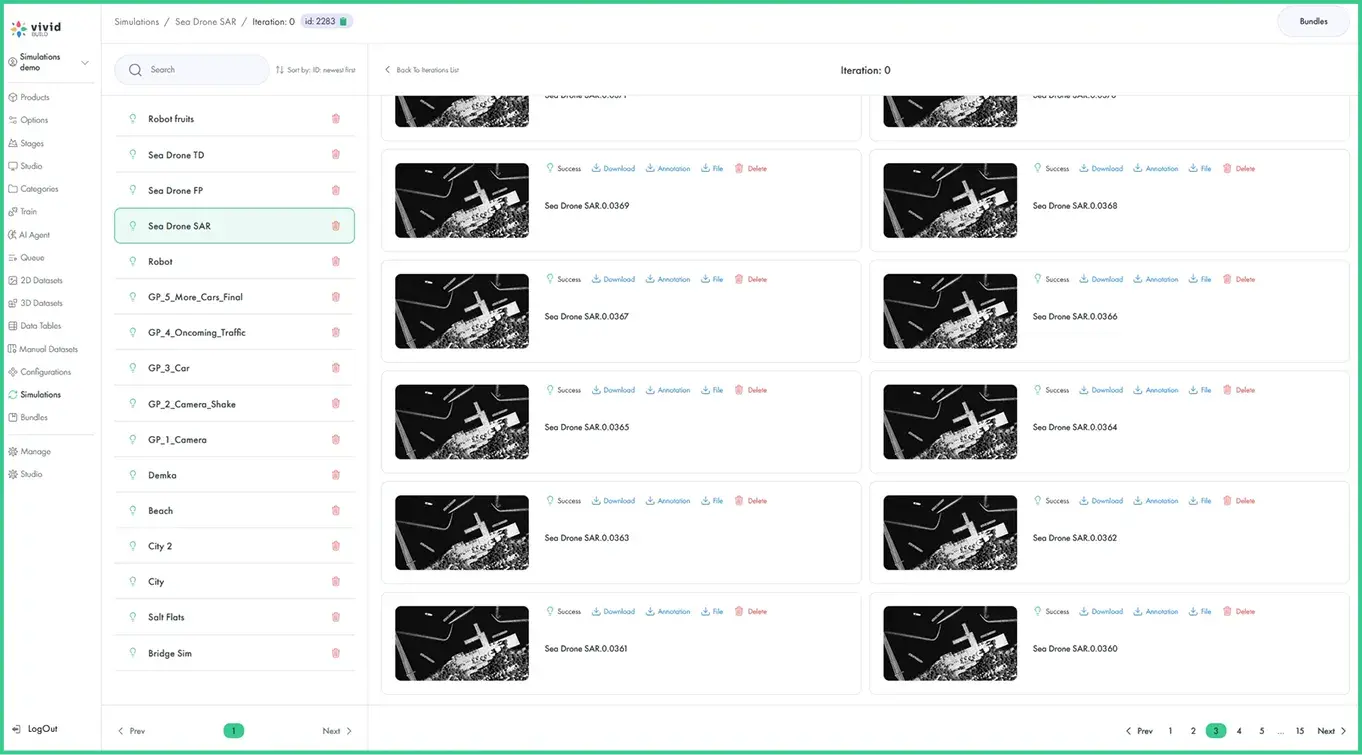
For visual AI - product recognition, object detection, AR - synthetic, CGI-rendered data is increasingly used to generate training sets at scale before real-world validation. Vivid 3D is one of the companies building this at platform scale - its Simulation Generator applies the approach to product datasets.
MIT researchers estimate that more than 60% of data used for AI applications in 2024 was synthetic - and that figure is growing.
What Real Data Is and What It Costs
Real data is any data collected from actual events: user behavior on a website, sensor readings from manufacturing equipment, medical records, images taken by a camera in the field, transactions processed by a payment system. Its value is that it reflects what the world actually looks like - including the noise, the outliers, the rare events, and the edge cases that no one thought to generate artificially.
The cost is everything else. Collection is slow. Labeling is expensive - human annotation at scale runs into millions of dollars for large computer vision datasets. Privacy regulations (GDPR, HIPAA, CCPA) restrict what you can do with data containing personal information, who can access it, and how long you can keep it. And for certain categories - medical imaging of rare conditions, failure events in industrial equipment, extreme weather scenarios for autonomous vehicle training - real data may simply not exist in the quantities a modern model needs.
There's also a less-discussed cost: real data reflects the world as it existed when it was collected. A model trained on last year's real data may not generalize well to this year's real world - especially in product categories, fashion, or any domain where visual appearance changes quickly.
What Synthetic Data Is and How It's Made
Synthetic data is generated algorithmically to replicate the statistical properties of real data without containing information from real sources. The goal is not to copy individual records - it's to produce new data that follows the same distributions, relationships, and patterns as the original.
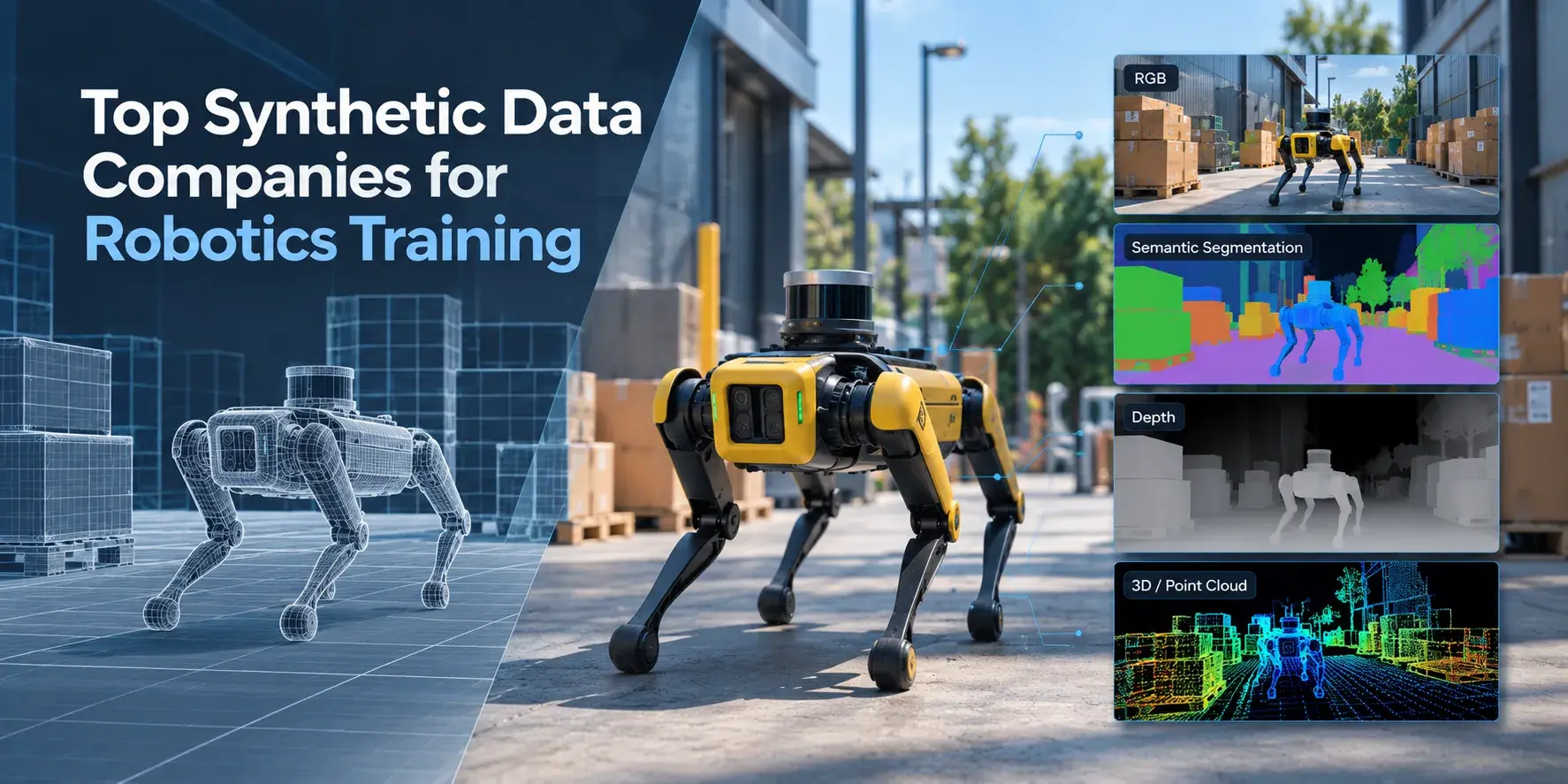
The generation methods differ by data type. For tabular data - transactions, demographics, sensor readings - generative models like GANs (generative adversarial networks) or variational autoencoders learn the statistical structure of a dataset and produce new rows that are statistically consistent with it. For language, LLMs are themselves synthetic data generators: every response is a synthetic output derived from training on real text. For images and video, 3D rendering engines - also called CGI (computer-generated imagery) pipelines - produce photorealistic synthetic images from controlled 3D scenes - specifying lighting, camera angle, object position, and material properties programmatically.
As Kalyan Veeramachaneni from MIT's Laboratory for Information and Decision Systems explains, the key shift in recent years isn't the concept - synthetic data has existed for decades - but the quality of generative models. "We can take a little bit of real data and build a generative model from that, which we can use to create as much synthetic data as we want. Plus, the model creates synthetic data in a way that captures all the underlying rules and infinite patterns that exist in the real data."
That's the promise. The problem is the word "all."
Where Synthetic Data Fails
Synthetic data fails in predictable ways, and most teams discover them after deployment rather than before.
The most common failure is distribution mismatch. A generative model learns from existing real data - which means its blind spots are your blind spots. If your real data underrepresented certain lighting conditions, object orientations, demographic groups, or failure modes, the synthetic data will underrepresent them too. The model trains on a sanitized version of reality and then encounters the unsanitized version in production.
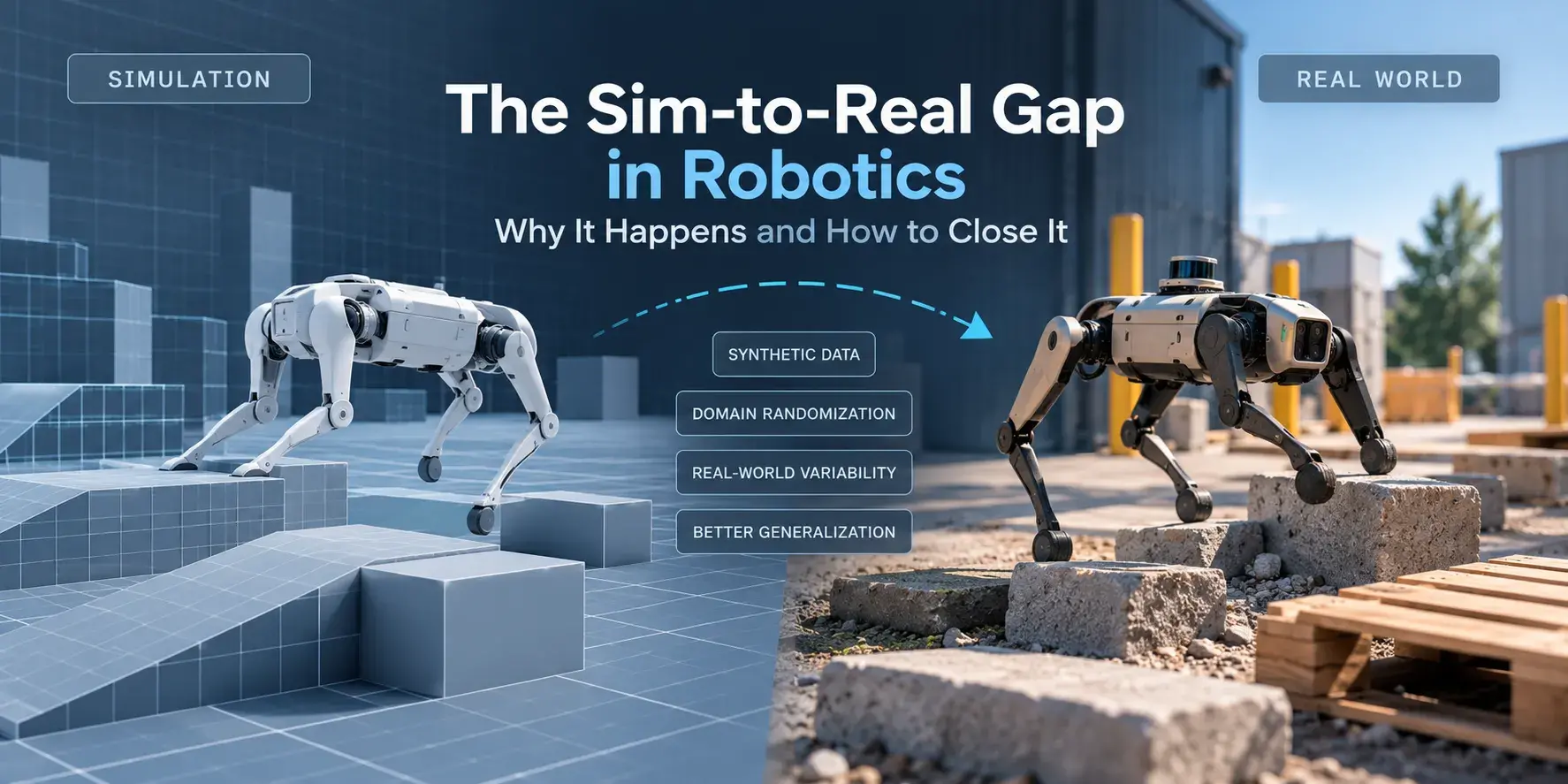
For visual AI specifically, the gap between synthetic renders and real-world images is a known problem. Render quality has improved dramatically - photorealistic 3D-generated images can be indistinguishable from photographs to human observers - but models often detect subtle differences that humans miss. Texture statistics, lighting artifacts, shadow behavior, and material reflectance in rendered scenes differ from camera-captured images in ways that affect model performance. This is the sim-to-real transfer problem: a model trained entirely on synthetic renders often performs worse on real images than the render quality would suggest.
The second failure mode is subtle: synthetic data that's too clean. Real data contains measurement noise, inconsistent labeling, sensor drift, and human error. These imperfections are part of what makes a model robust. Synthetic data generated from clean distributions may produce a model that performs brilliantly in testing and breaks in the field, because the field contains imperfections the training set didn't.
The third is privacy risk that isn't zero. Depending on the generation method and the original dataset, synthetic data can still encode patterns that allow inference about individuals in the source data - a risk that increases with small source datasets and sophisticated adversarial attacks. "Synthetic" does not automatically mean "safe to share externally" without validation.
Where Real Data Falls Short
Real data has its own failure modes, and they tend to get less attention because "just collect more real data" sounds like common sense.
Volume is the obvious one. For rare events - a specific product defect occurring in 0.01% of units, a medical condition affecting 1 in 100,000 patients, a specific failure scenario in autonomous vehicle operation - you may need to wait years or decades to collect enough real examples to train a model that handles them reliably. Synthetic data is the practical solution for these cases, not a workaround.
Privacy and regulation are a harder constraint than most teams anticipate. Training a model on customer behavioral data, medical records, or financial transactions creates ongoing legal exposure. The data may be usable internally under current rules, but sharing it with a research partner, a cloud vendor, or a new team member in a different jurisdiction introduces compliance risk. Synthetic data that preserves statistical properties without containing personal information is increasingly the standard approach for data sharing in regulated industries.
Cost and speed matter more than is usually admitted. A large annotated real-world image dataset for a computer vision model can cost millions of dollars and take months to produce. The same coverage achieved through synthetic rendering from 3D models can be generated in days for a fraction of the cost - and can be regenerated with different parameters (lighting, angle, occlusion, background) as many times as needed without additional collection.
The Comparison That Actually Matters
Dimension
Real data
Synthetic data
Origin
Collected from actual events, users, or sensors
Algorithmically generated to mimic real data distributions
Privacy risk
High - contains actual information about individuals
Low to moderate - depends on generation method and source
Collection cost
High - labeling, consent, storage, compliance
Low at scale once the generative pipeline is built
Volume scalability
Limited by collection rate and annotation capacity
Essentially unlimited once the generator is validated
Edge case coverage
Depends on how often edge cases occur in reality
Can be generated deliberately and at arbitrary volume
Distribution accuracy
Reflects the actual world, including unexpected patterns
Reflects what the generative model learned - blind spots included
Generally shareable - no personal information to expose
Model robustness signal
High - real noise and imperfection stress-test the model
Lower - overly clean distributions can hide fragility
The Use Case Breakdown
Synthetic data works well when:
You need volume that real data can't provide at reasonable cost. Training a computer vision model to recognize 10,000 product SKUs across varying lighting, angles, and backgrounds would require enormous photographic resources. Generating synthetic renders from 3D models - programmatically varying every parameter - is faster, cheaper, and produces more controlled coverage.
You need to cover rare events or dangerous scenarios. Autonomous vehicle training requires exposure to scenarios like pedestrian occlusion in unusual lighting, multi-vehicle pile-ups, and sensor failure in adverse weather. Most of these are too rare or too dangerous to collect in sufficient quantity from real-world driving. Synthetic simulation is the standard approach.
You need to share data across organizational or regulatory boundaries. A hospital can't share patient records with an external AI vendor. It can share a synthetic dataset that preserves the statistical structure of those records without exposing any individual. This is increasingly how medical AI development works in practice.
You need to train a model before real-world data exists. A manufacturer launching a new product line can generate synthetic training images from 3D CAD models before a single physical unit has been produced. The model is ready at launch, not six months after.
Real data remains essential when:
The task requires understanding genuine human behavior. Sentiment analysis, intent prediction, and natural language understanding benefit from real human expression in all its messiness. Synthetic text generated from a model already trained on real language is derivative - it captures patterns the model learned, not new patterns humans are actually producing.
The distribution of real-world inputs is unknown or highly variable. If you don't know what the real world looks like well enough to build a generative model that captures it accurately, synthetic data will encode your assumptions rather than reality. You need enough real data to validate whether your synthetic distribution is correct.
The stakes of distribution mismatch are high. Medical diagnosis, fraud detection, and safety-critical systems require that the training distribution closely match the deployment distribution. Synthetic data may produce a model that passes every benchmark and fails on the actual patient population or fraud pattern it encounters in production.
How This Plays Out in Visual AI and Product Data
One domain where the synthetic vs real debate is actively being resolved - rather than argued - is visual AI for products: object recognition, AR placement, quality inspection, and visual search.
The problem is concrete. Training a model to recognize a product and place it accurately in AR requires thousands of images of that product across varying conditions. For a catalog of 10,000 products, real photography is not a practical solution. The cost per product, multiplied by the number of angle, lighting, and background variations needed, is prohibitive.
The solution being adopted at scale is synthetic rendering from 3D models: generate photorealistic images programmatically, varying lighting, camera angle, background, and occlusion. The model trains on synthetic data and then gets fine-tuned or validated on a smaller set of real images. This is sim-to-real transfer - and the gap is narrowing as rendering quality improves.
Vivid 3D's Simulation Generator is built around exactly this workflow: the same 3D assets that power a product configurator can generate synthetic training datasets for computer vision models. The product model used for the ecommerce configurator becomes the source of the AI training data - the same governed asset library serving two distinct downstream workflows without duplication. For manufacturers and retailers building visual AI capabilities alongside their commerce stack, this convergence is what makes the investment in high-quality 3D assets compound over time rather than silo into a single use case.
The teams that are getting the most out of AI in 2026 aren't debating synthetic vs real. They're using synthetic data to bootstrap model training and cover the long tail of edge cases, and real data to validate that the synthetic distribution actually maps to the real world - and to fine-tune performance in production.
The ratio shifts by use case. Pre-launch product recognition: mostly synthetic, small real validation set. Medical imaging: real data where available, synthetic augmentation for rare conditions, careful validation before clinical use. Fraud detection: real transaction data with synthetic augmentation for fraud patterns that haven't yet appeared in sufficient volume.
The practical question isn't "synthetic or real?" It's: what can I generate synthetically that will hold up, what do I need real data for, and how much real data do I need to validate that the synthetic distribution isn't lying to me? Those are engineering questions with real answers - not a philosophical debate about which type of data is superior.
FAQ
What is synthetic data in AI?
Synthetic data is algorithmically generated data that mimics the statistical properties of real data without containing actual information from real-world sources. It can be tabular (generated by models like GANs), text (generated by language models), or visual (generated by 3D rendering engines). The goal is to produce data that trains a model as effectively as real data would, without the cost, privacy risk, or collection constraints of real data collection.
Is synthetic data as good as real data for training AI models?
Depends entirely on the task and the quality of the generative pipeline. For high-volume visual training data with controlled variation, synthetic data can match or exceed real data performance. For tasks that require understanding genuine human behavior, rare real-world distributions, or fine-grained sensor characteristics, real data is harder to replace. Most production AI systems in 2026 use a combination - synthetic data for volume and edge case coverage, real data for distribution validation and fine-tuning.
What is the main risk of using synthetic data?
Distribution mismatch: the synthetic data encodes your assumptions about the real world, not the real world itself. If your real data underrepresented certain conditions, your synthetic data will too - and a model trained on it will fail on those conditions in production. The second risk is overconfidence: a model trained on clean synthetic data can perform well in testing and poorly in the field, because real environments contain noise and edge cases the synthetic distribution didn't capture.
Why is synthetic data useful for privacy compliance?
Synthetic data preserves statistical structure without containing personal information from individuals in the source dataset. This makes it possible to share data across organizational or regulatory boundaries - with research partners, cloud vendors, or teams in different jurisdictions - without exposing the underlying personal records. In healthcare, finance, and telecom, this is increasingly the standard approach to enabling AI development under GDPR, HIPAA, and similar regulations.
What is sim-to-real transfer?
Sim-to-real transfer is the process of training a model on data generated in a simulated environment and then deploying it in the real world. The challenge is that simulated and real environments differ in ways that affect model performance - texture statistics, lighting behavior, sensor characteristics, and physical dynamics. Sim-to-real transfer research focuses on closing this gap, either by improving simulation fidelity or by fine-tuning on a smaller set of real data after synthetic pre-training.
Can synthetic data be used for computer vision training?
Yes, and it's increasingly common for large-scale product recognition, quality inspection, and AR placement tasks. 3D rendering engines can generate photorealistic images of products across arbitrary lighting, angle, and background variations - producing training sets that would be impractical to build through real photography at the same scale. The key validation step is testing model performance on real images to confirm that the synthetic distribution generalizes correctly to real-world conditions.