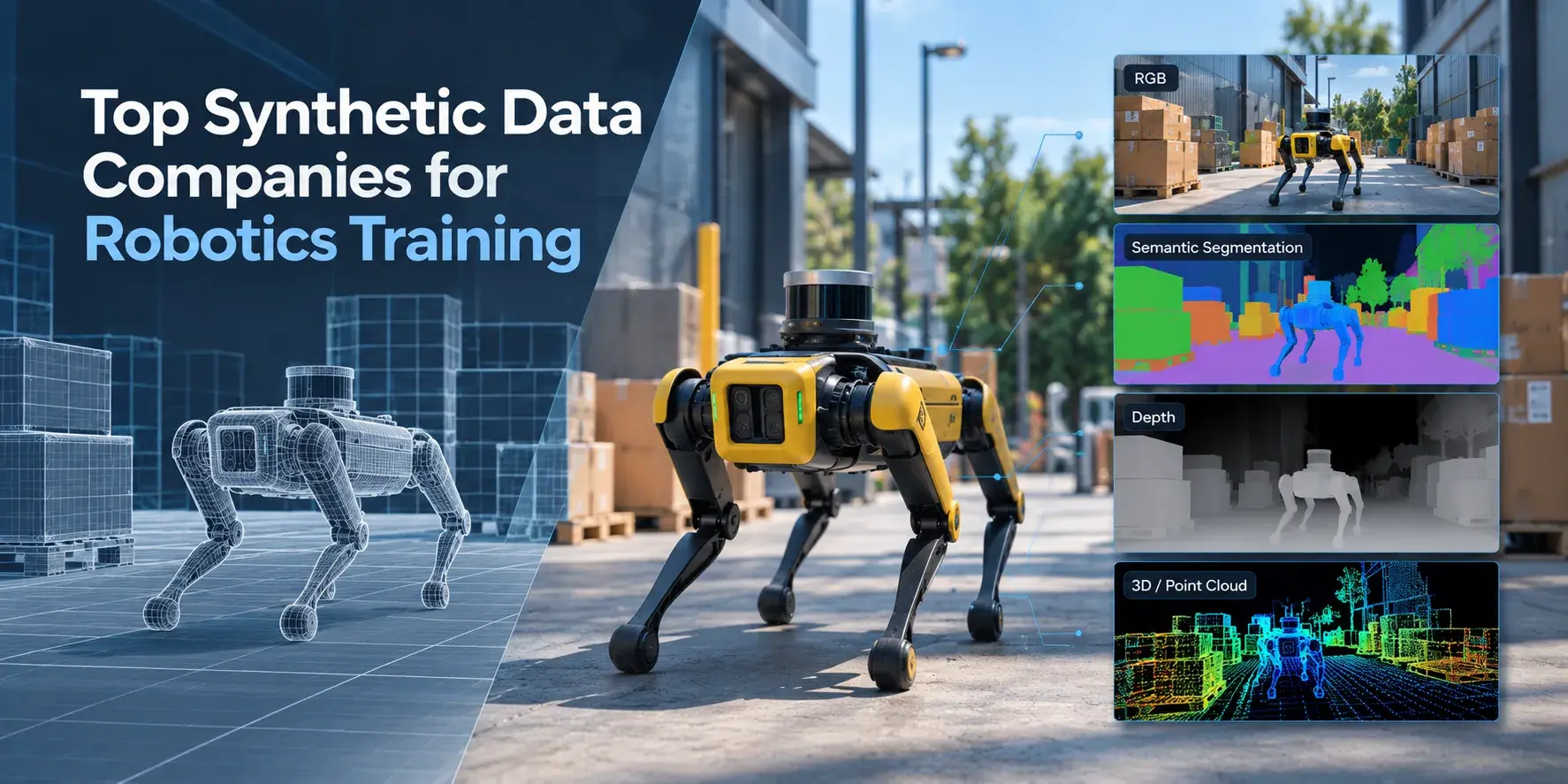
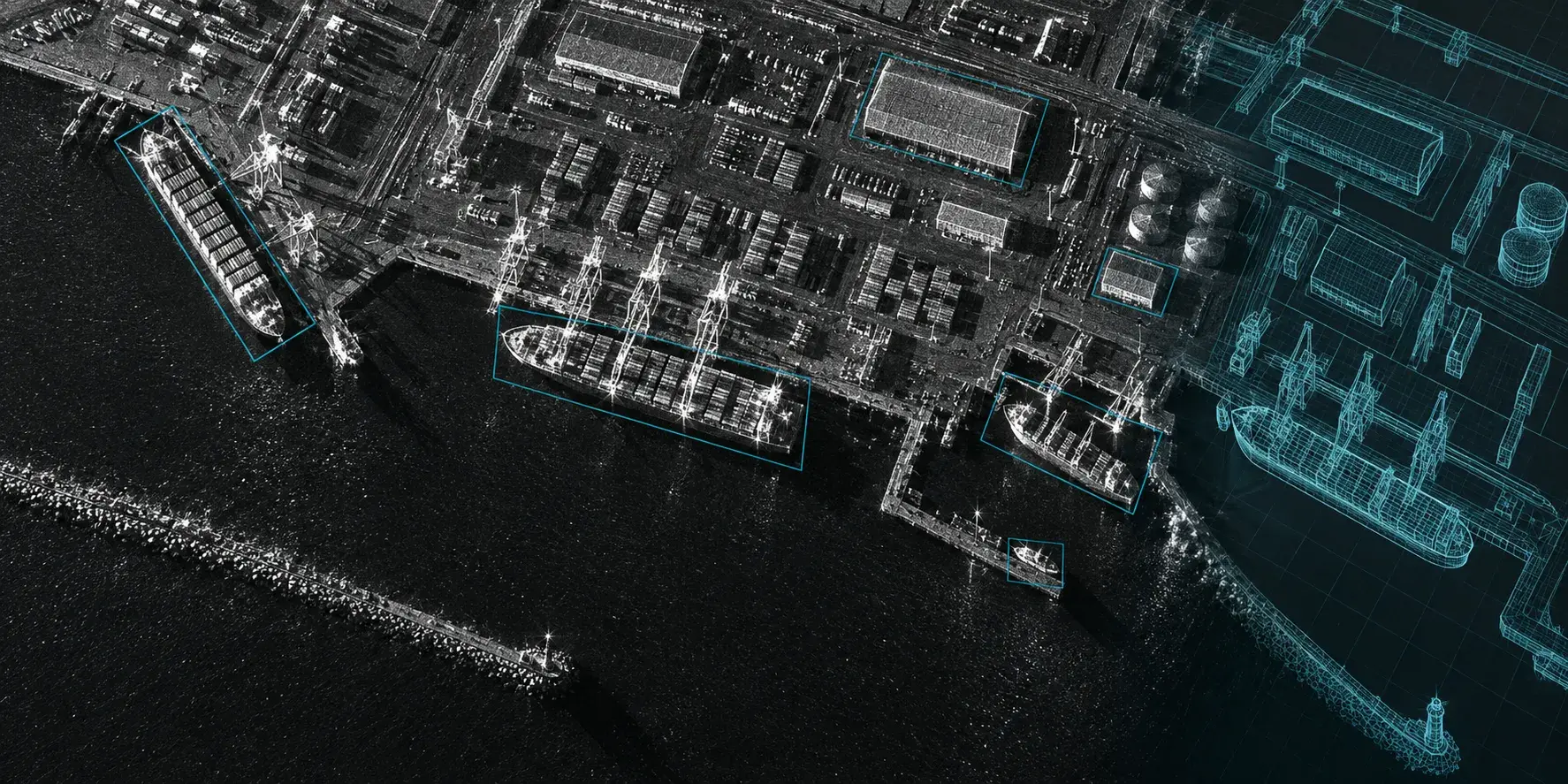
Most lists of synthetic data companies for robotics training mix two very different businesses together: companies that render 3D scenes to generate data, and companies that pay people to operate real robots and record what happens. Both matter for training a robot policy. They are not the same product, they do not solve the same problem, and comparing their pricing side by side without saying so is how a buying decision goes wrong. This guide covers the companies actually building simulation and rendering pipelines for robotics, what they cost relative to real-world collection, and where the approach still has limits.
What Counts as Synthetic Data for Robotics (and What Doesn't)
Synthetic data, in the sense this article uses it, means training data generated from a 3D scene, a virtual camera, and a physics engine rather than captured from a real robot or a real environment. NVIDIA Isaac Sim rendering a warehouse floor and generating depth maps for it is synthetic data. A remote operator wearing a VR headset to guide a real robotic arm through a folding task, with the session recorded and labeled afterward, is not, no matter how often the two get grouped under the same robot training data heading in market reports.
That distinction matters because the vendors serving each side look almost nothing alike. Companies like Scale AI, Physical Intelligence, and iMerit build teleoperation rigs, hire and manage operators, and turn real demonstrations into labeled datasets. Their value is in physical fidelity: a real gripper actually closing on a real object carries information a renderer cannot fully fake yet. Companies covered in this article instead build the scene, the sensors, and the physics, then let a render engine generate as many labeled variations as the training run needs. Neither category is strictly better. They solve different parts of the same data problem, and most serious robotics teams end up buying from both.
Synthetic Data Companies for Robotics Training at a Glance
| Company |
Core approach |
Best for |
Ground truth output |
| NVIDIA Isaac Sim |
Physics-based robot simulation on Omniverse |
Manipulation and locomotion policy training |
Depth, segmentation, pose, joint state |
| Vivid 3D |
3D-asset-first, built on existing product and CAD libraries |
Teams that already hold 3D assets and need edge case coverage fast |
Bounding boxes, segmentation, depth, audit trail |
| Parallel Domain |
Multi-sensor scenario simulation |
Perception testing across camera, lidar, radar |
Bounding boxes, segmentation, sensor-matched noise |
| Rendered.ai |
Configurable simulation graphs per customer |
Narrow, technically demanding sensor requirements |
Custom, defined per pipeline |
| SKY ENGINE AI |
Rare-failure and anomaly rendering |
Defect and malfunction detection in industrial robots |
Multispectral, segmentation |
| Anyverse |
Physically accurate sensor simulation |
Camera and lidar model validation before deployment |
Raw sensor-level output, not just RGB |
| Mindtech |
Scene generation for human-robot interaction |
Collaborative and service robotics |
Pose, segmentation, interaction labels |
The Companies
NVIDIA Isaac Sim
Isaac Sim is NVIDIA's robotics-specific simulation environment, built on the Omniverse platform. It handles the physics side seriously: objects have mass, friction, and collision behavior, which matters once a policy has to learn how to grip something without crushing or dropping it. Isaac Lab sits on top of it with reusable training environments, so a team does not have to build a warehouse or a kitchen scene from scratch just to start iterating. The tradeoff is that Isaac Sim is closer to infrastructure than a turnkey dataset. Teams without in-house simulation engineers tend to find the learning curve steeper than vendors that ship a finished pipeline.
Vivid 3D
Vivid 3D takes a different starting point than a general-purpose simulation engine like Isaac Sim. The platform started as a 3D asset and configurator system for ecommerce and manufacturing, and that same asset library and rendering pipeline now doubles as a source of synthetic training data for robotics and Physical AI. In practice, that means a manufacturer that already has CAD models of its own equipment does not need to rebuild scenes from scratch to start generating labeled training data from them. The tradeoff runs the other way from an infrastructure platform built for engineers to configure: less flexibility for scenarios that have nothing to do with an existing 3D asset, more speed for teams that already have the geometry and need edge case coverage without a multi-month asset-building phase first.
Parallel Domain
Parallel Domain built its reputation in autonomous vehicles before extending into robotics and infrastructure inspection, and the strength carries over directly: scenario control across every sensor a perception stack depends on at once. A team can specify a scene, a lighting condition, and an occlusion pattern, then get matched camera, lidar, and radar output for it rather than generating each sensor's data separately and hoping they line up. That matters more for robotics than it sounds, since a warehouse robot's perception stack often fuses two or three sensor types, and training data that does not stay consistent across them teaches the model the wrong thing.
Rendered.ai
Rendered.ai does not lock customers into a fixed content library the way some vendors do. Instead, teams configure their own simulation graph, defining the objects, sensors, and physics rules specific to their use case. That flexibility suits robotics applications with unusual requirements, an industrial arm working with irregular parts, a mobile robot navigating a non-standard facility layout, where a generic warehouse asset pack would not match the real deployment closely enough to be useful.
SKY ENGINE AI
SKY ENGINE AI's angle is the long tail: generating the rare failure and anomaly cases that a working robot almost never produces on its own. A robotic inspection system needs to recognize a cracked weld or a misaligned bearing before it happens on the line, not after, and real production data mostly consists of parts that are fine. Its platform renders defect variations at a density no factory floor would naturally generate, which is closer to an insurance policy than a general data source.
Anyverse
Anyverse specializes in physically accurate sensor simulation rather than scene content. It models the actual optics, noise characteristics, and spectral response of a specific camera or lidar unit, so the synthetic training distribution matches what the sensor will output in the field instead of a generic camera approximation. For robotics teams validating a new sensor before committing to hardware at scale, that level of fidelity is often the deciding factor over a vendor with a bigger asset library but a looser sensor model.
Mindtech
Mindtech's Chameleon platform focuses on scenes involving people, which puts it in a different lane from the pure-perception vendors above. Collaborative robots and service robots need to predict what a nearby human is about to do, not just detect that one is present, and Mindtech's synthetic humans are built specifically to cover that range of gesture, posture, and interaction. It serves retail and smart home applications too, but the human-interaction depth is what makes it relevant to robotics teams working near people rather than around them.
What These Companies Actually Cost Compared to Real-World Data Collection
The number that gets repeated most often in this space is the cost gap between real and synthetic collection, and it is large enough that vague talk of cheaper undersells it. Real-world demonstration data runs anywhere from about $6 to $11 per demonstration for a simple pick-and-place task, climbing to $54 to $157 per demonstration once the task involves bimanual manipulation or deformable objects, according to a cost breakdown published by the Silicon Valley Robotics Center. That is before quality assurance overhead, and before the operator time needed to set up each session.
Synthetic generation does not eliminate cost, but it moves the bill from labor to compute, and compute scales differently. Once a scene and its asset library exist, generating another thousand labeled variations is a matter of render time rather than booking more operator hours. That difference in how cost scales is part of why the market is growing as fast as it is. A 2026 market report from Research and Markets puts the synthetic data generation market for robotics at 2.48 billion dollars in 2026, projected to reach 7.71 billion dollars by 2030.
None of that means synthetic data is free to produce well. Building the first version of a scene, tuning domain randomization so it actually generalizes, and validating that a model trained on the output performs on real test data all take real engineering time. The savings show up on the second, third, and hundredth variation of a scenario, not the first.
Where Synthetic Data Still Falls Short
Simulation still struggles with contact physics. A render engine can place an object in a gripper with pixel-perfect labels, but the actual friction, deformation, and force feedback of that contact are approximated, not measured, and the gap between an approximated grip and a real one is exactly where a lot of manipulation policies fail when they move from simulation to a physical robot. Material properties are a related weak point: a synthetic scene can specify that a surface is glass or rubber, but light and force do not always behave the way the label says they should once a real camera and a real gripper are involved.
This is why the current research consensus, and the practice at most serious robotics labs, treats simulation and real data as complements rather than a replacement for one or the other. Teleoperation and real demonstrations anchor a policy to true physical behavior. Simulation covers the volume and the edge cases that would take months of real-world scheduling to encounter naturally, a rare object configuration, an unusual lighting condition, a failure mode nobody wants to cause on purpose with a real robot. Buying into one category exclusively usually costs a team more than it saves, in either direction.
How to Choose a Synthetic Data Company for Robotics
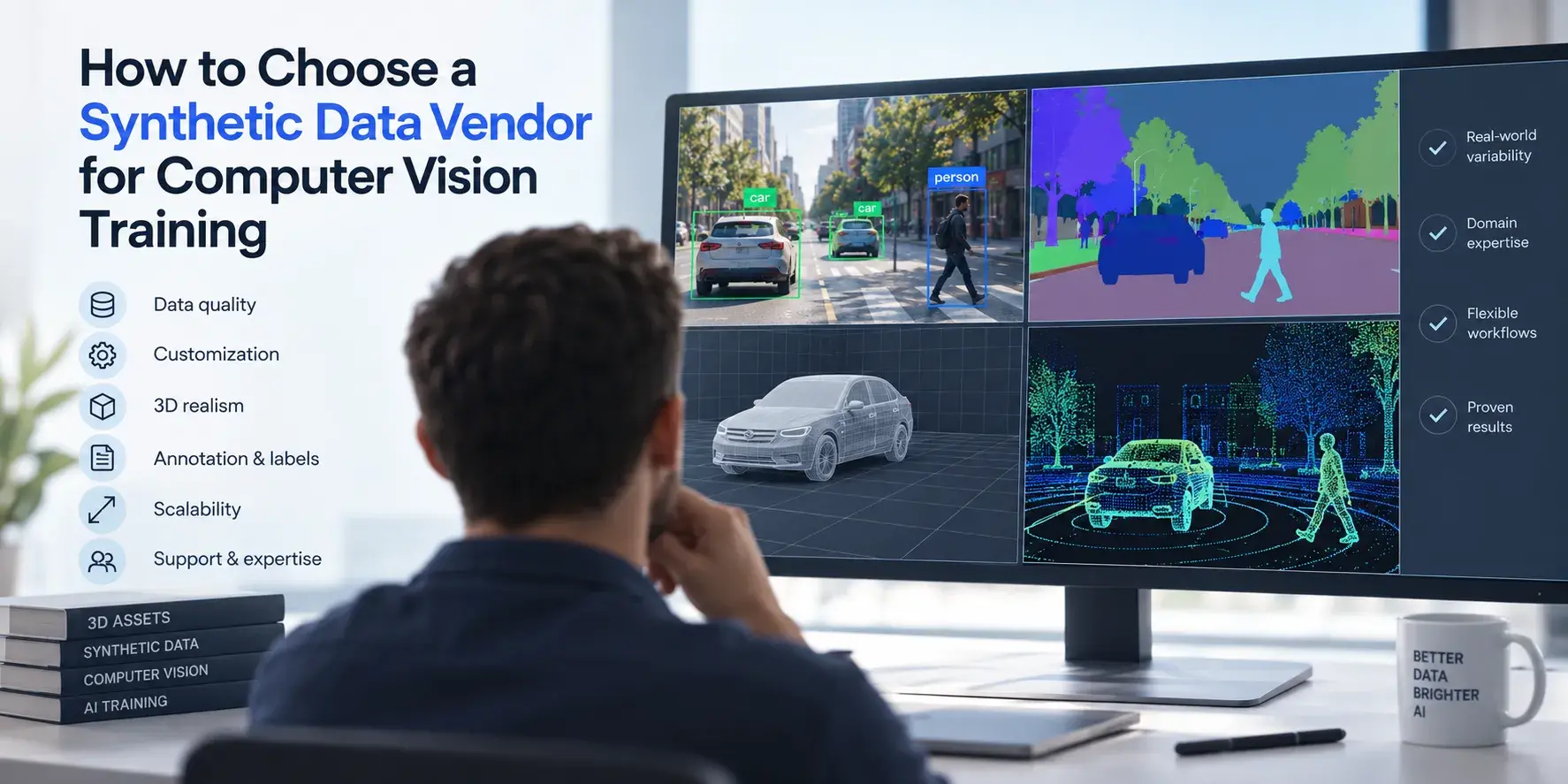
The evaluation criteria for this category overlap with synthetic data vendor selection generally, and a fuller framework for evaluating synthetic data vendors covers the broader version of this decision. For robotics specifically, a few questions carry more weight than the rest:
- Does the vendor simulate physics with enough fidelity for the task, or only geometry and appearance? A perception-only pipeline is fine for classification tasks but will not prepare a policy for manipulation.
- Can the platform work from a team's existing 3D or CAD assets, or does every new object require rebuilding from scratch inside the vendor's own asset library?
- Does the vendor provide sim-to-real validation evidence, meaning a model trained on their data has been shown to perform on a real robot, not just on a held-out synthetic test set?
- Is pricing structured around a fixed dataset or an ongoing simulation pipeline the team can reconfigure as new object classes or scenarios come up?
Teams evaluating synthetic data companies for robotics training tend to get the best outcome by treating this as a pilot decision first and a platform decision second: run one real scenario through a candidate vendor's pipeline, validate the output against a real test set, and only then commit to a broader contract.
Frequently Asked Questions
Why is synthetic data important for robotics training?
It lets teams generate labeled training data for scenarios that are rare, dangerous, or expensive to produce with a real robot, a rare object configuration, a failure mode, an unusual lighting condition, without waiting for a real-world schedule to encounter them naturally.
Can synthetic data replace real-world data completely?
Not in current practice. Simulation approximates contact physics and material behavior rather than measuring them directly, so most production pipelines mix synthetic data for volume and edge cases with real demonstrations that anchor a policy to true physical behavior.
What types of sensors can synthetic data simulate?
Camera, depth, lidar, and radar are the most commonly simulated sensors in robotics pipelines, with vendors like Anyverse and Parallel Domain going further to model the specific noise and optical characteristics of an individual sensor rather than a generic approximation.
Is simulation data enough for robotics, or does a team need real demonstrations too?
Most robotics teams need both. Simulation is strongest for pre-training, edge case coverage, and testing perception under conditions that are hard to arrange in the real world, while real demonstrations remain the more reliable source for fine-tuning a policy close to deployment.
How should a robotics team evaluate synthetic data companies for robotics training?
Start with physics fidelity for the specific task, whether the vendor can work from existing 3D or CAD assets, and whether they can show a model trained on their data actually performing on a real robot. A short pilot on one real scenario, validated against a real test set, answers more of that than a vendor's demo reel ever will.