The defects a quality team most wants to catch are usually the ones it has the fewest images of. A hairline crack that shows up once every 40,000 parts. A coating flaw that only appears after a supplier changes resin. A solder bridge that hides under one specific lighting angle. You know what you want the model to flag, but the training set to teach it does not exist yet.
Synthetic data for industrial defect detection is how manufacturers get around that. Instead of waiting months for real failures to accumulate, teams generate labeled images of products, surfaces, and defects under controlled conditions, then use them to train an AI inspection model before the line has produced enough real examples. It does not replace real data. It removes the cold-start problem that stalls most inspection projects before they reach production.
What is synthetic data for industrial defect detection?
Synthetic data for defect detection is artificially generated visual data used to train, test, and improve machine vision models for quality inspection. It represents real products and real defects, but the images are produced from 3D models or generative pipelines rather than captured on a camera in the plant.
A useful synthetic dataset is not a pile of industrial-looking pictures. It has to be tied to the actual part, the actual defect criteria, and the pass-or-fail decision the quality team makes. In practice that dataset includes clean surfaces that show acceptable variation, defect examples such as scratches, cracks, dents, inclusions, and coating problems, and pixel-level masks that mark exactly where each defect sits. Every image also carries labels for defect type, size, location, and severity.
That last part matters more than most teams expect. A model trained on image-level labels alone learns “this photo contains a defect somewhere.” A model trained on masks learns which pixels are the defect and which are just the grain of the material. On textured or reflective surfaces, that difference decides whether the system works.
Why real defect data falls short
The standard advice for any AI project is to collect more data. For defect detection, that advice quietly assumes the defects are available to collect. Often they are not.
Rare defects and imbalanced datasets
A well-run line produces very few defects, which is good for the business and painful for model training. If a critical flaw occurs in less than one part per thousand, building a balanced dataset by waiting could take a year. Deep learning models trained on a handful of positive examples overfit to those specific images: the exact scratch length, the exact position, the exact lighting. Show them a slightly different version of the same defect and they miss it.
Synthetic data attacks the imbalance directly. From a few real examples, you can generate the same defect at different sizes, angles, contrast levels, and positions, and across multiple product variants. The model sees the pattern instead of memorizing one photo. This is also the fastest way to build coverage for edge cases that real production has not thrown at you yet, a problem Vivid 3D covers in more depth in its guide on how to generate edge cases for computer vision models.
The manual labeling bottleneck
Even when real images exist, someone has to label them. Drawing a tight mask around a 3-pixel-wide crack is slow, needs a trained eye, and varies from person to person. One inspector calls a mark a scratch, another calls it a scuff, a third accepts it. The model then learns those inconsistencies as signal.
Synthetic data sidesteps the bottleneck because the mask is generated at the same moment as the defect. The system already knows where it placed the flaw, so the annotation is exact and consistent across the whole set. Labeling stops being a manual chore and becomes a byproduct of generation.
How synthetic defect data is generated
There are two dominant approaches, and the right choice depends on how much you know about the part’s geometry and how realistic the surface needs to look. Most mature pipelines end up using both.
3D and CAD-based rendering
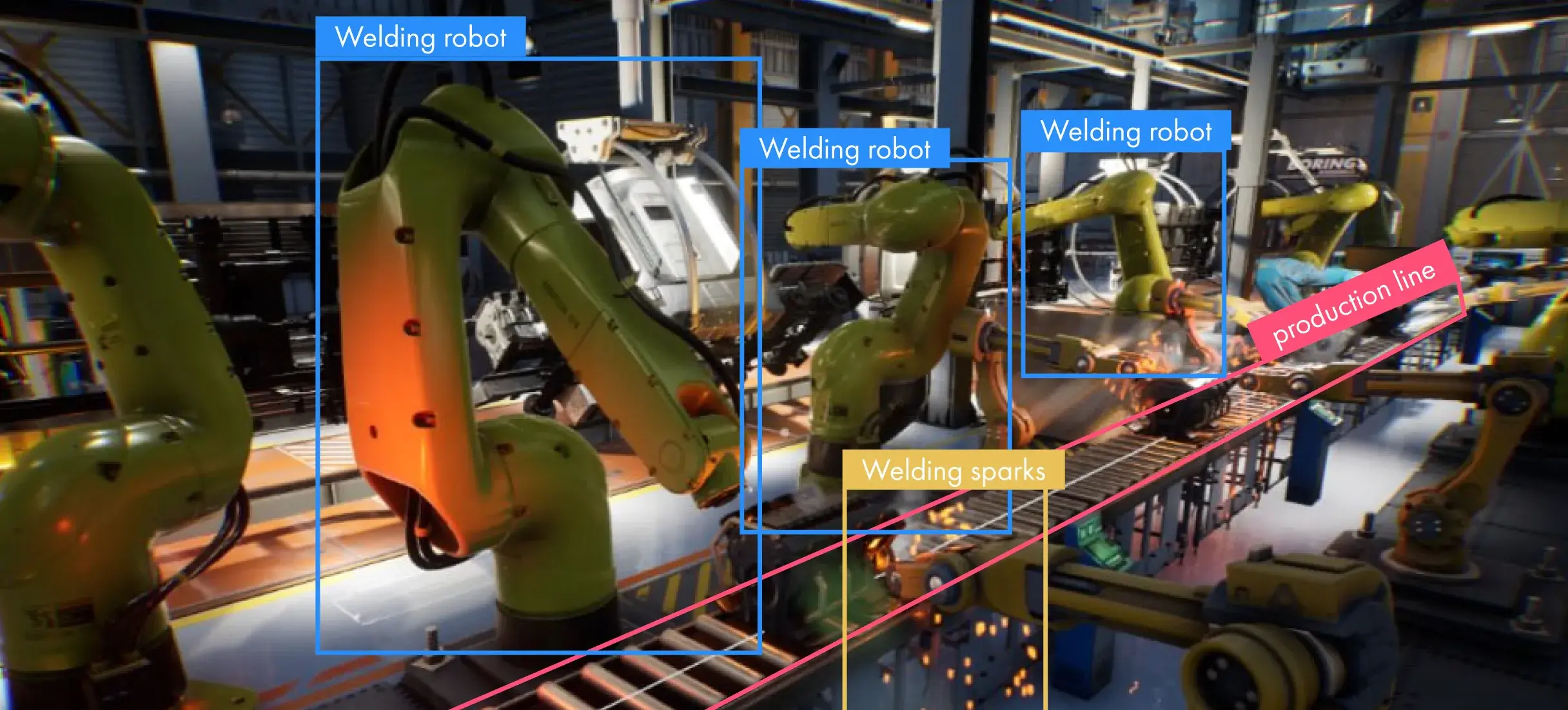
Here you start from a 3D model of the part, often the same CAD file used in design, and render images of it with defects added to the geometry or texture. Because the scene is fully controlled, you get automatic ground-truth labels, precise defect placement, and the ability to sweep through lighting, camera angle, and material properties programmatically.
The strength is control. You can render a dent at 200 positions and 15 severities overnight, each with a perfect mask. The cost is setup: you need a decent 3D asset and a physically plausible way to model how the defect and the light interact. For a fuller breakdown of the options, Vivid 3D’s technical guide to synthetic data generation methods walks through the pipelines in detail.
Generative models such as GANs and diffusion
Generative approaches learn the distribution of real images and produce new samples that look like they came from the same line. GANs and diffusion models are strong when the surface is hard to model explicitly, textiles, leather, brushed metal, organic textures, where a hand-built 3D material would never look convincing enough.
The trade-off runs the other way from rendering. Realism can be excellent, but control and guaranteed labels are harder. A generative model may produce a beautiful defect in a place your taxonomy does not care about, or drift away from the real product if the training samples were thin. In production, teams often generate defect variants with a diffusion model and then verify each one against the taxonomy before it enters the training set.
Automatic masks and labels
Whichever method you use, the payoff that makes synthetic data economical is auto-annotation. Every generated image ships with its mask, class, severity, and location baked in. A dataset of 5,000 labeled defect images that would take weeks to annotate by hand can be produced and labeled in a fraction of the time, and with none of the inspector-to-inspector drift.
Method trade-offs at a glance
No single generation method wins on every axis. This is roughly how the two main approaches compare on the factors that decide an inspection project.
| Factor |
3D / CAD rendering |
Generative (GAN / diffusion) |
| Label accuracy |
Exact, automatic ground truth |
Needs verification against taxonomy |
| Surface realism |
Strong when geometry is known |
Strong for textured, organic surfaces |
| Control over defect placement |
High and repeatable |
Lower, harder to constrain |
| Setup requirement |
3D asset or CAD file |
A representative set of real images |
| Best fit |
Rigid parts, known geometry |
Complex or non-uniform materials |
Closing the sim-to-real gap
The single biggest reason synthetic data fails is the sim-to-real gap. A model trained purely on clean renders learns the look of the simulator, not the look of the plant. Then it meets a real camera with real noise, real dust, and lighting that shifts across the shift, and its accuracy drops.
Domain randomization is the standard fix. Instead of trying to make every render photorealistic, you deliberately vary the things that do not matter, background, lighting direction, minor color shifts, sensor noise, so the model learns to ignore them and focus on the defect. The counterintuitive result is that adding more visual variety, even unrealistic variety, often transfers better to real images than a narrow set of perfect ones.
The second fix is a hybrid dataset. Mixing synthetic images with a small fraction of real data, commonly in the range of 5 to 10 percent real, tends to give much stronger results than either source alone. The synthetic data supplies volume and rare-defect coverage. The real data anchors the model in true production conditions.
Where synthetic data delivers the most value
Synthetic data is not equally useful everywhere. It earns its keep when the inspection task matters but the data is scarce, imbalanced, or slow to label.
Rare defect detection is the textbook case. When a costly flaw appears too infrequently to collect, generating variations lets the model learn it before it recurs on the line. New product variants are close behind: high-mix manufacturers launching new colors, finishes, or SKUs rarely have defect history for them, and synthetic examples let a new variant come online without months of waiting.
Non-uniform surfaces are another strong fit. Textiles, composites, glass, coated metal, and stone all have natural variation that confuses simple systems, because the model has to separate acceptable texture from a true anomaly. Synthetic data can teach both sides of that line. The pattern shows up across industries: automotive teams train on scratches, dents, and assembly faults in body panels and engine components; electronics manufacturers target solder defects and misaligned components on PCBs; packaging lines look for cracks, seal failures, and mislabeling.
Expensive or destructive defects round out the list. Some flaws you simply cannot afford to create hundreds of times to build a dataset. Modeling them synthetically avoids scrapping real product. Manufacturing is one of the core verticals Vivid 3D builds for, and its manufacturing and industrial page covers how these cases map to a full inspection pipeline.
Validating synthetic data before you train
A lot of teams treat validation as something that happens after training, when they test the finished model. That is too late to catch a bad dataset. If the synthetic images do not reflect real product appearance, the model learns the wrong thing and you find out only after burning the training cycle.
Checking quality up front is cheaper. Before a single epoch runs, review whether the generated defects actually match the defect taxonomy, whether the surface realism holds up against real reference images, and whether the distribution of sizes, positions, and severities covers what the line really produces. Filtering out examples that do not match production reality is one of the highest-leverage steps in the whole workflow. Vivid 3D has a dedicated walkthrough on how to validate synthetic data quality before model training for teams setting this up.
None of this removes the final step. A model trained with synthetic data still has to be tested against real, production-like images before anyone trusts it on the line. Synthetic data accelerates the path to a working model. Real validation is what earns the trust to deploy it.
How to start: what manufacturers need to provide
You do not need a massive dataset to begin. In most cases the useful starting inputs are a set of clean product images, a few real defect examples, and a defect catalogue or QC checklist. CAD files, scans, or calibrated photos help the 3D route. Product variant details, tolerance thresholds, and severity rules shape what gets generated.
The most valuable input is usually not data at all. It is a clear definition of the decision. Which defects must always fail? Which are measured by size or location? Which surface variation is acceptable and should never trigger a reject? What happens when the model is uncertain? A defect taxonomy that answers those questions turns synthetic generation from a technical experiment into a production tool, because every generated example can carry the right class, mask, and decision context.
Where Vivid 3D fits
Vivid 3D runs a synthetic data pipeline built for computer vision, aimed at exactly this problem: manufacturers who have a clear inspection target but not enough labeled defect images to train against it. The approach starts from a small set of clean and defect samples, generates realistic labeled variations with masks and metadata, and grounds the output in the real product and its defect criteria so it validates against production images rather than looking good only in a demo.
Because the same platform handles generation, edge-case coverage, and validation, teams move from a few samples toward a production-ready dataset without stitching together separate tools. You can see how the pieces connect on the synthetic data for computer vision platform page. If you are still weighing how much synthetic versus real data your line actually needs, the comparison in synthetic data vs real data is a useful next read.
Frequently Asked Questions
Can synthetic data replace real defect images?
Not entirely. Synthetic data is strongest for expanding rare defects, balancing the dataset, and cutting labeling work. Real images stay essential for calibration, validation, and final production testing, which is why most successful projects use a hybrid of both.
How many real images do manufacturers need to start?
Fewer than most teams assume. Many projects begin with a set of clean product images, a small number of real defect examples, and a clear QC checklist. More real images mainly improve validation confidence rather than being a prerequisite to start.
Does synthetic data work for rare defects?
Yes, and rare defects are its strongest use case. From a few real samples you can generate the defect at many sizes, positions, and severities, so the model learns the visual pattern long before enough real failures accumulate on the line.
How are synthetic defects labeled?
Automatically. Because the pipeline places the defect, it also generates the mask, class, severity, and location at the same time. That removes the manual annotation bottleneck and eliminates the inconsistency you get when different inspectors label the same image.
How do you validate a model trained with synthetic data?
Test it against real or production-like images. Check that it detects true defects, does not false-reject acceptable variation, handles product variants, and holds up under the plant’s real camera and lighting before it goes live.