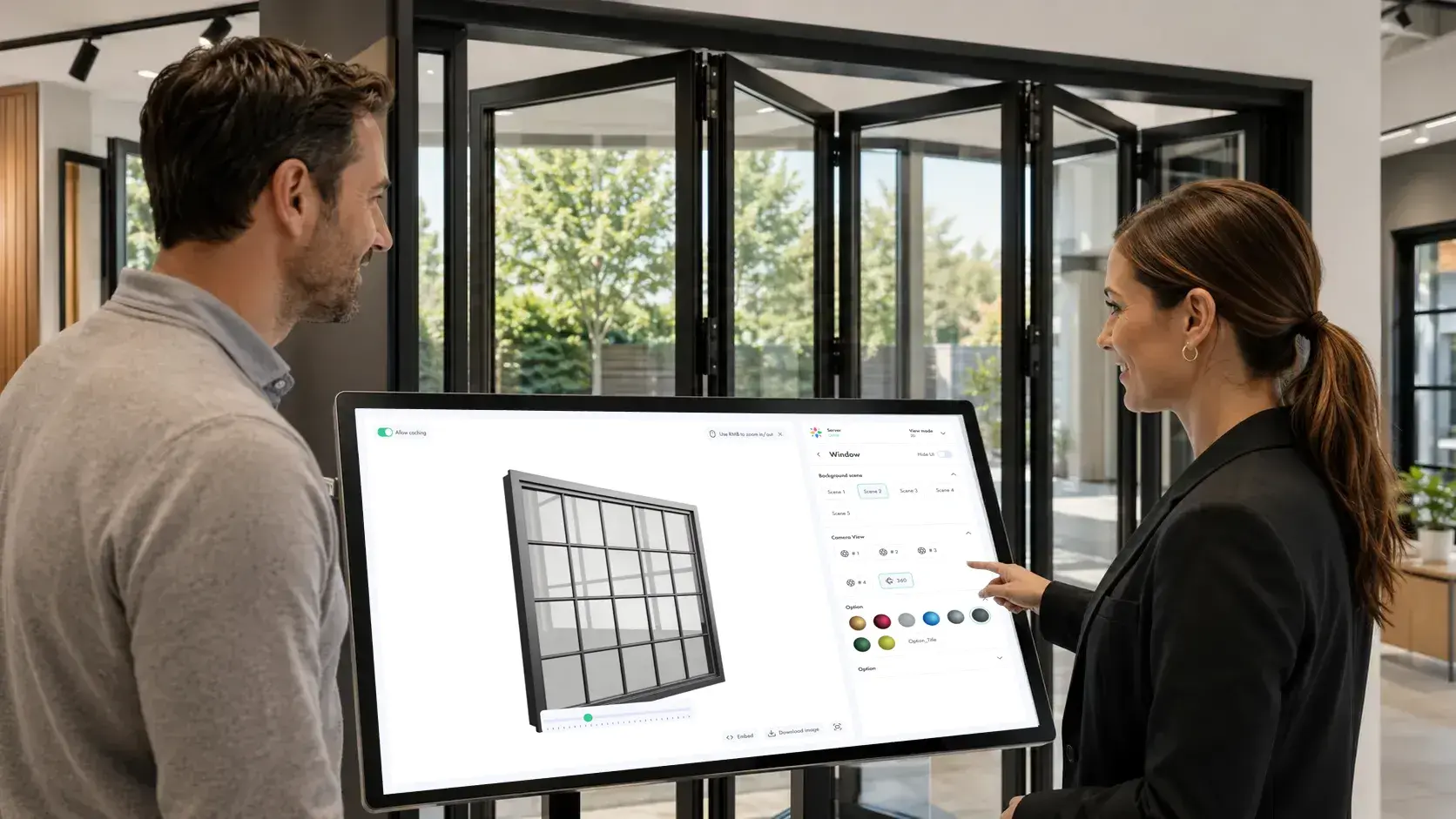
How Window and Door Configurators Simplify Complex Product Sales
How Window and Door Configurators Simplify Complex Product Sales
3D Content Production (Pipelines & Standards)
9 min read
Technical blogger
Diego Santos
Updated:
18 Aug 2026
Posted:
19 Aug 2026
A homeowner walks into a showroom wanting a bi-fold door. Twenty minutes later the conversation has spiraled into frame materials, glazing units, threshold details, RAL colors, and hardware sets, and the salesperson is scribbling notes to "check with the factory and get back to you." That follow-up is where deals go to die. A window and door configurator exists to keep that sale in the room, letting the buyer see, price, and confirm a valid custom product before they lose interest.
Windows and doors are some of the most configurable products anyone sells. The catch is that the complexity that makes them valuable is the same complexity that stalls the sale. This article looks at where that friction comes from and how a configurator removes it, not just for the design, but for the close.
Why selling windows and doors is so complicated
Most products have a handful of variants. A single casement window can have thousands. That gap is the root of nearly every problem in fenestration sales.
Too many interdependent options
One unit pulls in custom sizing measured to the millimeter, frame materials like aluminium, uPVC, timber, or composite, glazing that runs from single pane to triple-glazed low-emissivity units, gas fills, hardware for handles and hinges and locks, hundreds of finish codes, and energy ratings that have to satisfy local building standards.
None of these choices sit still. Go up a frame size and some glazing options drop away. Pick triple glazing and the extra weight changes which hinges are allowed. Choose a particular timber species and half the finish palette disappears. A static PDF or a page of dropdown menus cannot enforce those relationships, so a rep can quote a combination that simply cannot be built. Nobody finds out until the order hits engineering, or worse, the installer is already on site.
What that complexity costs the sales team
Every one of those variables is a chance for the sale to stall. The rep has to know the rules, remember the exclusions, and translate all of it into a number the customer trusts. In practice that means the quote leaves the room. It goes to a technical colleague, comes back a few days later, and by then the buyer has three competing quotes and a cooling interest.
Manual order entry across manufacturing runs error rates around 10% or higher, according to order-management research cited across the industry. In custom fenestration each unit is made to order and cannot be returned to stock, so a single wrong entry is not a restock, it is scrap. The sales problem and the production problem are the same problem: information degrading every time a human re-types it.
What a window and door configurator actually does
A window and door configurator is software that lets a customer or salesperson build a product on screen, choosing dimensions, materials, glazing, hardware, and finishes, while rules run in the background to keep every combination valid and every price current. Instead of a spec sheet, the buyer works with a live 3D model that updates as they change it.
Underneath the visual is a parametric model, a set of geometric relationships and manufacturing constraints. Enter a width outside tolerance and the tool flags it before the order exists. Switch from double to triple glazing and it recalculates the U-value and weight, then quietly removes hardware that can no longer carry the panel. The buyer never sees an impossible product because the software will not draw one.
This is the line between a simple visualizer and a real configurator, and it is worth understanding the difference between a configurator as a tool versus a connected system before you shop. The visual is the part customers notice. The rule engine is the part that protects the sale.
Turning a slow quote into a same-session sale
The single biggest thing a configurator changes is timing. Traditional quoting is a relay: the customer describes what they want, the rep transcribes it, an engineer validates it, and a price comes back days later. Each handoff adds delay and a chance for the number to be wrong.
A configurator collapses that relay into one screen. Material cost, labor, and margin update live as the buyer configures, so the price they see is the price the factory can honor. Fenestration fabricators running integrated digital workflows have reported quotation turnaround improving by as much as 70%. When the quote is instant and accurate, the decision happens while the buyer is still engaged instead of after they have gone quiet.
That speed also reshapes the negotiation. A buyer who can watch the price move as they swap triple glazing for double, or a premium finish for a standard one, makes their own trade-offs against budget. There is no back-and-forth, no "let me check." The configurator hands the customer the levers, and people close faster on a decision they made themselves.
Fewer errors mean fewer deals falling apart
An error in a custom window order is not just a production cost. It is a sales reversal. The customer signed off on something that cannot be built, and now someone has to call them back, re-quote, and rebuild trust that was already fragile.
Because a configurator validates every choice at the moment it is made, the specification the customer approves is the specification the factory receives. Nothing gets transcribed, so nothing gets garbled. Manufacturers who move to specialized digital tools have reported cutting production errors by roughly 40% and speeding quoting by around 60%. Those numbers usually get framed as factory savings, but the sales impact is just as real: an order that ships correctly the first time is a customer who refers the next one, not one who disputes the invoice.
Letting anyone sell like an expert
Deep product knowledge is scarce and slow to train. A configurator moves that knowledge out of the veteran rep's head and into the software, so a new hire, a dealer, or the customer themselves can build a correct order without memorizing the rulebook.
This is guided selling in the truest sense. The tool asks the right questions in the right order, hides invalid paths, and surfaces relevant upgrades at the moment they make sense. A dealer three states away configures a compliant order on a showroom tablet at 8pm with no factory rep on the line. For manufacturers who sell through networks of dealers and contractors, that reach matters as much as any single closed deal, which is why many treat a dedicated window and door configurator as core sales infrastructure rather than a website widget.
It also changes the self-service equation. Some buyers want a rep; others want to explore quietly on their own before they ever make contact. A configurator serves both. The homeowner who wants to price options at midnight gets to, and the lead that reaches the sales team arrives already qualified, already specified, and much closer to a signature.
From configured order to the factory floor
A sale is not finished when the customer says yes. It is finished when the right product ships. This is where a configurator earns the rest of its keep, by carrying the buyer's exact configuration straight into production without a manual rewrite.
When the order is confirmed, the parametric model can generate the bill of materials, cutting lists, and production drawings automatically, then pass them to the ERP or workshop system. The design intent the customer created in the browser becomes the instruction set on the shop floor, intact. This is the point where a configurator overlaps with configure, price, quote (CPQ) software: the configurator handles the valid, visual build, and the CPQ layer handles pricing logic, approvals, and the formal quote. It helps to be clear on how a sales configurator differs from a product configurator so you buy the capability your process actually needs.
What to look for in a window and door configurator
Not every tool that renders a 3D window can run a fenestration business. The demos all look similar, so judge the engine, not the animation.
Start with the rule system. It has to enforce real manufacturing constraints, size tolerances, material compatibility, weight limits, and energy thresholds, and it has to do that without a developer editing code every time your product line changes. Ask how a new frame profile or hardware set gets added, and by whom.
Then look at the output. A configurator that produces a pretty picture but no BOM or cutting data just moves the manual re-entry one step later. The valuable ones generate production-ready files and push them into your existing systems. Real-time, rule-accurate pricing is the third non-negotiable, since a quote the factory cannot honor is worse than no quote at all. Platforms built for manufacturers, Vivid 3D among them, pair the visual configurator with this rule and output layer so the same tool that closes the sale also feeds the factory. Before committing, it is worth reading how vendors talk about the ROI of a 3D product configurator and pressure-testing those claims against your own quote volume and error rate.
Frequently Asked Questions
What are the major features of a window and door configurator?
The core features are real-time 3D visualization, rule-based validation that blocks invalid combinations, live pricing tied to real production costs, and automatic generation of production data like bills of materials and cutting lists. The visualization sells the product; the rules and outputs make the sale buildable.
What is the difference between a product configurator and a sales configurator?
A product configurator focuses on building a valid, manufacturable product, enforcing the technical rules of what can actually be made. A sales configurator emphasizes the commercial side: guided selling, pricing, quoting, and upsell prompts. Many fenestration platforms combine both, and CPQ software often sits alongside them to handle approvals and formal quotes.
How does a configurator reduce errors in custom window and door orders?
It validates every choice the moment it is made, so a buyer cannot approve a combination that violates size, weight, or compatibility rules. Because the approved specification passes into production without being re-typed, the transcription errors common in manual quoting disappear. Manufacturers using these tools commonly report large drops in production errors.
Do customers or salespeople use the configurator?
Both, and that flexibility is part of the point. Homeowners can self-serve online and arrive as pre-qualified, pre-specified leads. Dealers and in-house reps use the same tool to build correct orders on a showroom tablet without calling the factory, which lets less experienced staff sell complex products confidently.