Best Product Configurator and Quoting Software for Window and Door Companies in 2026
Best Product Configurator and Quoting Software for Window and Door Companies in 2026
3D Content Production (Pipelines & Standards)
8 min read
Technical writer
John Fresco
Updated:
July 15, 2026
Posted:
July 8, 2026
Window and door companies are asking software to do more than generate a PDF quote. The best tools in this space now connect visual product configuration, real-time pricing, manufacturing constraints, and in some cases 3D visualization and AR preview - all in one workflow. The market has split into three distinct categories, and buying the wrong one is a common and expensive mistake.
This guide covers all three: production-linked CPQ systems for manufacturers and dealers, 3D visual configurators for sales and ecommerce, and job management tools for installers and replacement contractors.
At a Glance
Software
Category
Best for
3D / Visual
Production-linked
Market
Vivid 3D
3D Visual Configurator
Manufacturers scaling visual sales and AI workflows
Yes - photorealistic
Via integration
Global
Paradigm Omni
CPQ / Production
Manufacturers and dealer networks
Partial
Yes
North America
Cyncly
CPQ / ERP
Full-stack manufacturers needing ERP + CPQ
Yes
Yes
Global
Twikit
3D CPQ
Custom window/door manufacturers needing 3D + production
Yes - 3D CPQ
Yes
Europe
WinDoor Quote
CPQ / Production
Manufacturers scaling dealer networks
Partial
Yes
North America
JobNimbus
CRM / Job Management
Replacement contractors
No
No
North America
Tommy Trinder
Quoting
UK installers, fast quoting
No
No
UK
WindSketch
Visual Quoting
Elevation-based visual quoting
Elevation drawings
No
UK / Europe
FitterPal
Job Management
Small installers, full admin workflow
No
No
UK
Three Categories, Three Different Problems
The window and door software market looks unified from the outside. It isn't. The tools that dominate in each of these three categories solve fundamentally different problems and almost never substitute for each other.
Production-linked CPQ systems connect product configuration directly to fabrication data. A dealer quoting through Paradigm Omni or Cyncly produces a validated spec the factory can build - not just a price. Configuration logic enforces manufacturing constraints at the moment of entry. BOMs and production orders are generated automatically. This is the category that window and door manufacturers have built their operations around for decades.
3D visual configurators solve a different problem: getting customers to engage with a product before they commit. Static product photography can't show every material combination, finish option, or custom dimension. A 3D configurator does - in real time, on any device, with photorealistic output and AR preview. For manufacturers selling direct-to-consumer or through retail channels, this is where conversion rates and return rates move. It's also where the 3D asset library becomes reusable infrastructure for marketing, sales enablement, and AI training data.
Installer and job management tools are for the companies on the other end of the supply chain - the ones measuring openings, quoting homeowners, scheduling crews, and invoicing. They need survey-to-quote-to-invoice workflow, not manufacturing specs. The best tools in this category connect those steps on a single record so data enters once and flows through.
Most businesses need tools from one category. Some need two. Very few need all three - but knowing which you're in is the starting point for any software decision.
The Best Tools by Category
Vivid 3D - Best 3D Visual Configurator for Window and Door Manufacturers
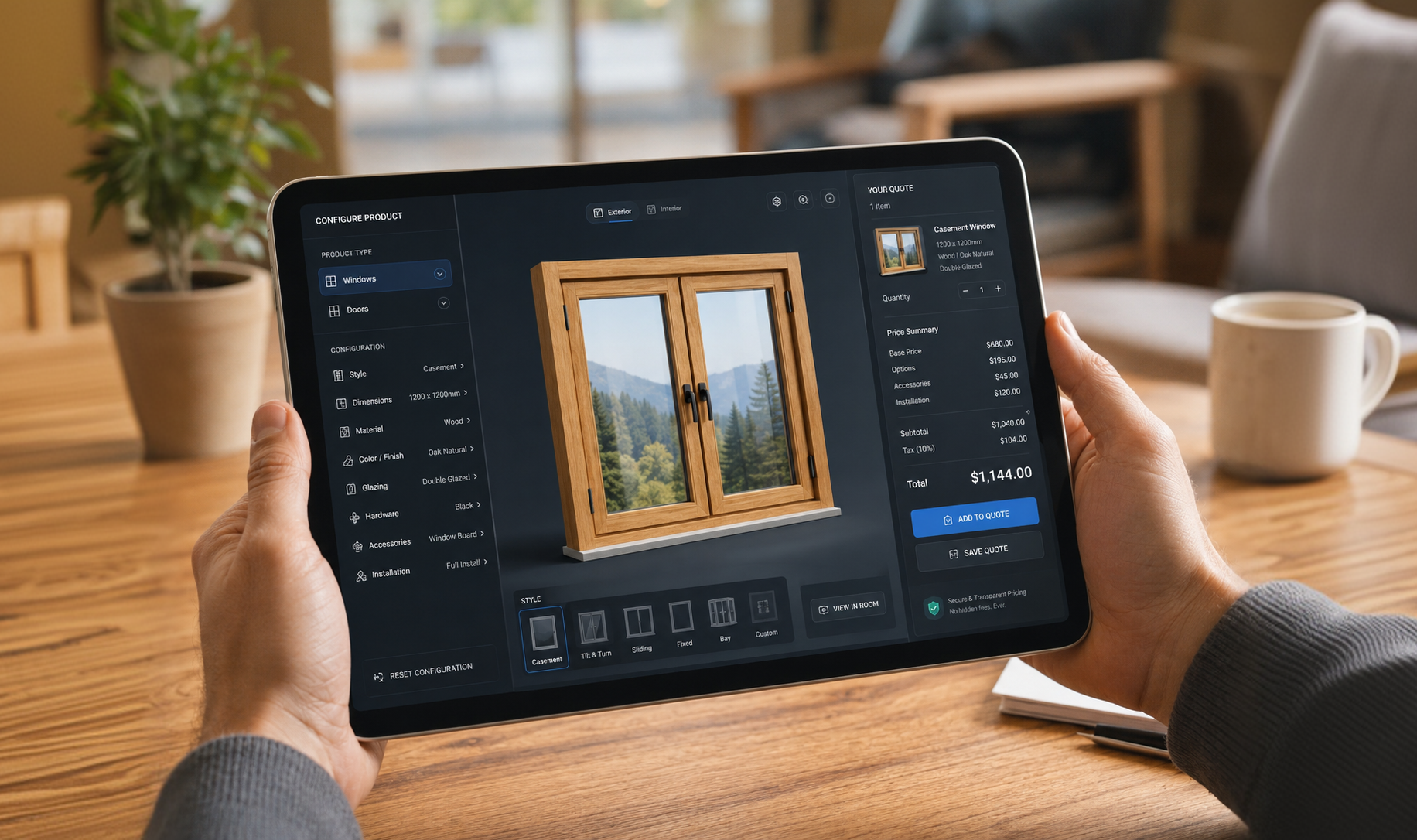
Vivid 3D is a Visual Data Platform that covers the full 3D content lifecycle - from asset creation and management through to product configuration, photorealistic rendering, AR preview, and synthetic data generation for AI and computer vision workflows. For window and door manufacturers, this means one platform can handle the 3D assets for your product configurator, generate marketing imagery across all material and finish combinations, and create synthetic training datasets for visual recognition models - all from the same governed 3D library.
Vivid.Build handles product configuration: material swaps, finish options, dimension variants, and rule-based constraint logic that prevents invalid combinations. Vivid.Player publishes those configured experiences anywhere - embedded on a product page, inside a dealer portal, or in a showroom kiosk - with native AR capability for mobile devices. Vivid.Studio creates full 3D scenes and marketing environments from the same assets. Vivid.Simulation Generator produces synthetic training data from those assets for computer vision and AR placement workflows.
For window and door manufacturers already investing in 3D assets for their product range, the reuse model matters: the same 3D models that power your configurator can generate your entire marketing image library across every material and finish combination, without a photoshoot. That changes the economics of maintaining a large product catalog significantly.
Vivid 3D integrates with major ecommerce platforms and connects via API to ERP and order management systems - so the visual layer connects to the operational layer without requiring a rebuild. Living Spaces, Lippert Components, and Hastings Tile and Bath are among the enterprise customers running on the platform.
Best for window and door manufacturers who want photorealistic 3D configuration on their product pages, AR preview for buyers, and a 3D asset pipeline that serves marketing and AI workflows alongside sales. Pairs well with a production-linked CPQ system for the manufacturing output layer. See the full Vivid 3D platform overview.
Paradigm Omni - Best Production-Linked CPQ for North American Manufacturers
Paradigm Omni is the industry default for window and door manufacturers and their dealer networks in North America. The platform connects manufacturers and dealers through a single quoting and configuration system where a validated dealer quote is simultaneously a production spec. Configuration logic enforces manufacturing constraints, precise visualisations cover mulling combinations and grille patterns, and integrated catalog management keeps pricing accurate across the dealer network.
What makes it the default isn't marketing - it's operational track record. Manufacturers who have tried general-purpose CPQ tools and found they don't handle fenestration product complexity keep coming back to Paradigm. The cloud-hosted, multi-channel catalog management and insights into quote, order, and sales data are features that only matter once you're running at scale.
Best for North American manufacturers running dealer networks who need production-accurate quoting. Not the right tool for direct-to-consumer visual sales or for installers.
Cyncly - Best Full-Stack Platform for Manufacturers Needing ERP + CPQ
Cyncly is the result of consolidating several established fenestration software brands - including FeneVision, Window Designer, and V6 Advantage - under one platform. It serves the full window, door, and glass manufacturing value chain: profile suppliers, flat glass fabricators, residential and commercial window and door manufacturers, and distributors.
The depth is real. V6 Advantage handles precise product configuration with instant digital twin drawings, quotes, BOMs, and production data. FeneVision is a full ERP for window and door manufacturing. Window Designer is purpose-built for the UK market. The platform connects design, quoting, production, and delivery in a single workflow, which reduces the errors that come from passing data between disconnected systems.
The tradeoff is complexity. Cyncly is a significant commitment - implementation requires real resources and the platform scope can be more than most businesses need. It earns that commitment for manufacturers running complex operations across multiple production lines or distribution channels.
Best for manufacturers who need the full stack - CPQ, production management, and ERP in a connected system. Overkill for smaller operations or businesses that only need the quoting layer.
Twikit - Best 3D CPQ for Custom Window and Door Manufacturers in Europe
Twikit occupies the intersection of 3D visual configurator and production-linked CPQ - a combination that most platforms in this space don't cover cleanly. For manufacturers of custom, high-end windows and doors where the configuration is genuinely complex and the visual output needs to match the production spec, Twikit's workflow connects real-time 3D visualization to manufacturing automation.
The Portapivot case study on their site shows what this looks like in practice: customers configure bespoke doors online with dimensions, materials, partitions, and hardware, see the result in real-time 3D, and the output connects directly to laser cutting and production scheduling. The entire flow from customer design to fabrication-ready data runs through one system.
Best for European manufacturers of custom, premium windows and doors where 3D visualization and production automation need to connect. Less relevant for standard product ranges where simpler quoting tools are sufficient.
WinDoor Quote - Best Cloud-Native Quoting for Manufacturers Scaling a Dealer Network
WinDoor Quote is a cloud-based ERP quoting platform for window, door, screen, and partition manufacturers. It's the practical alternative to Paradigm for manufacturers who want production-linked dealer quoting without the enterprise implementation overhead. Recent updates added in-platform payment processing, digital PDF signing, and instant email proposals - all fully web-based.
The core value proposition is moving dealer networks off manual Excel-based price sheets onto instant, accurate, visual quotes. One manufacturer described the shift plainly: dealers went from manual calculations that were slow and error-prone to instant pricing with product visuals.
Best for manufacturers building or scaling a dealer network in North America who want cloud-native simplicity. The gap versus Paradigm and Cyncly shows at enterprise scale.
JobNimbus - Best Job Management for Replacement Contractors
JobNimbus is a CRM and project management platform for contractors. It's not window-specific but its mobile-first design and full job lifecycle coverage make it the most cited option among North American window replacement contractors. It supports line-item quoting, scheduling, invoicing, and customer communication from a single platform with a strong mobile app for on-site work.
It doesn't have window-specific configuration tools, fabrication data, or production output. For replacement contractors quoting standard installed products at the homeowner's home, that's the right tradeoff. For anyone who needs configuration accuracy in the quote or production connection on the output, it isn't.
Best for replacement contractors managing leads, quotes, scheduling, and invoicing in one place. Not suitable where production-accurate configuration matters.
Tommy Trinder - Best Fast-Start Quoting for UK Installers
Tommy Trinder is the most common first step for UK installers moving off Word documents. Fast to set up, professional output, mobile-ready. The documented gap: it doesn't link to fabrication data and doesn't support direct order placement with fabricators. The quote is a sales document, not a production spec. At low-to-medium volume that's workable. At higher volume, the manual handoff to fabrication becomes a daily cost.
Good starting point for UK installers. The fabrication data gap becomes a bottleneck as volume grows.
WindSketch - Best Elevation-Based Visual Quoting
WindSketch generates elevation drawings of window and door configurations at property level - showing the customer what their house will look like with the specified products. Consistently recommended in industry forums for visual selling on-site. Not job management software - teams using it typically run it alongside a separate CRM for scheduling and invoicing.
Right for installers who close on visuals. Needs a separate system for everything after the quote.
FitterPal - Best Integrated Workflow for Small Installers
FitterPal connects survey, quote, job, and invoice on a single record so data enters once and flows through. For small installation businesses where the real pain is admin overhead between steps rather than quoting speed, it addresses the actual problem. Not relevant for manufacturer-grade quoting or production output.
Best for small installation businesses where admin chain is the bottleneck. Not a substitute for manufacturer-grade configuration systems.
How to Choose
What's your position in the supply chain? Manufacturers and dealers need production-linked quoting or 3D visual configuration depending on whether the bottleneck is manufacturing accuracy or buyer confidence. Installers need job management. These are different problems and different tools.
Is the problem commercial or operational? If buyers can't visualize the product, return rates are high, or the product catalog is too complex to represent with photography - that's a 3D configurator problem. If quotes take too long, contain errors, or don't connect to production - that's a CPQ problem. Both matter, but solving the wrong one first wastes time and budget. The difference between a sales configurator and a product configurator explains this split in detail.
Do you need one tool or two? A manufacturer selling through dealers and direct-to-consumer often needs both a production-linked CPQ for dealer quoting and a 3D visual configurator for the consumer channel. Vivid 3D connects to ERP and order management via API, so it pairs with Paradigm Omni or Cyncly rather than replacing them. The configurator tool vs system distinction is useful here - the visual layer and the production layer serve different users and different outputs.
What does your 3D asset situation look like? If you have no 3D models, the first investment is asset creation. If you have CAD files, they can be converted to web-ready GLB format. If you already have 3D assets for marketing or manufacturing, a platform like Vivid 3D can deploy them across configuration, ecommerce, and AI workflows without rebuilding. See how 3D modeling connects product design and sales for context on the full pipeline.
FAQ
What is a product configurator for window and door companies?
A product configurator for window and door companies is software that lets customers or sales teams customize a product - selecting dimensions, materials, finishes, hardware, and glazing options - and see the result in real time. Production-linked configurators validate those choices against manufacturing constraints and generate BOMs and production specs automatically. Visual configurators show a photorealistic 3D render or AR preview to help buyers make confident decisions before purchase.
What is the best window quoting software for manufacturers?
For production-linked quoting, Paradigm Omni is the North American industry standard and Cyncly covers the full manufacturing stack globally. For 3D visual configuration alongside sales and marketing, Vivid 3D covers photorealistic product configuration, AR preview, and multi-channel publishing from a single asset library. For manufacturers scaling a dealer network, WinDoor Quote is a cloud-native alternative with lower implementation overhead.
Can a 3D configurator replace CPQ software for window manufacturers?
Not directly - they solve different problems. A 3D visual configurator like Vivid 3D handles buyer-facing customization and visual output. A CPQ system like Paradigm Omni handles dealer quoting, pricing logic, and production specs. Manufacturers selling through dealers typically need both: the visual layer for direct-to-consumer sales and the production layer for dealer network management. The two integrate via API rather than substituting for each other.
What is the best quoting software for window installers?
For full job lifecycle management in North America, JobNimbus is the most commonly used platform among window replacement contractors. For UK installers wanting survey-to-quote-to-job workflow, FitterPal connects those steps without heavy setup. For elevation-based visual quoting that wins at the kitchen table, WindSketch is consistently recommended by installers who sell on visuals.
How does AR work for window and door product pages?
Web-based AR lets buyers point their smartphone camera at a wall or opening and see a configured window or door product placed in their actual space - scaled correctly and with their chosen material and finish. For furniture and home products, this directly reduces returns and increases purchase confidence. Platforms like Vivid 3D handle AR delivery through Vivid.Player, which publishes configured 3D products to any website with iOS Quick Look and Android WebXR support. For the full technical guide, see how to implement AR on a website.