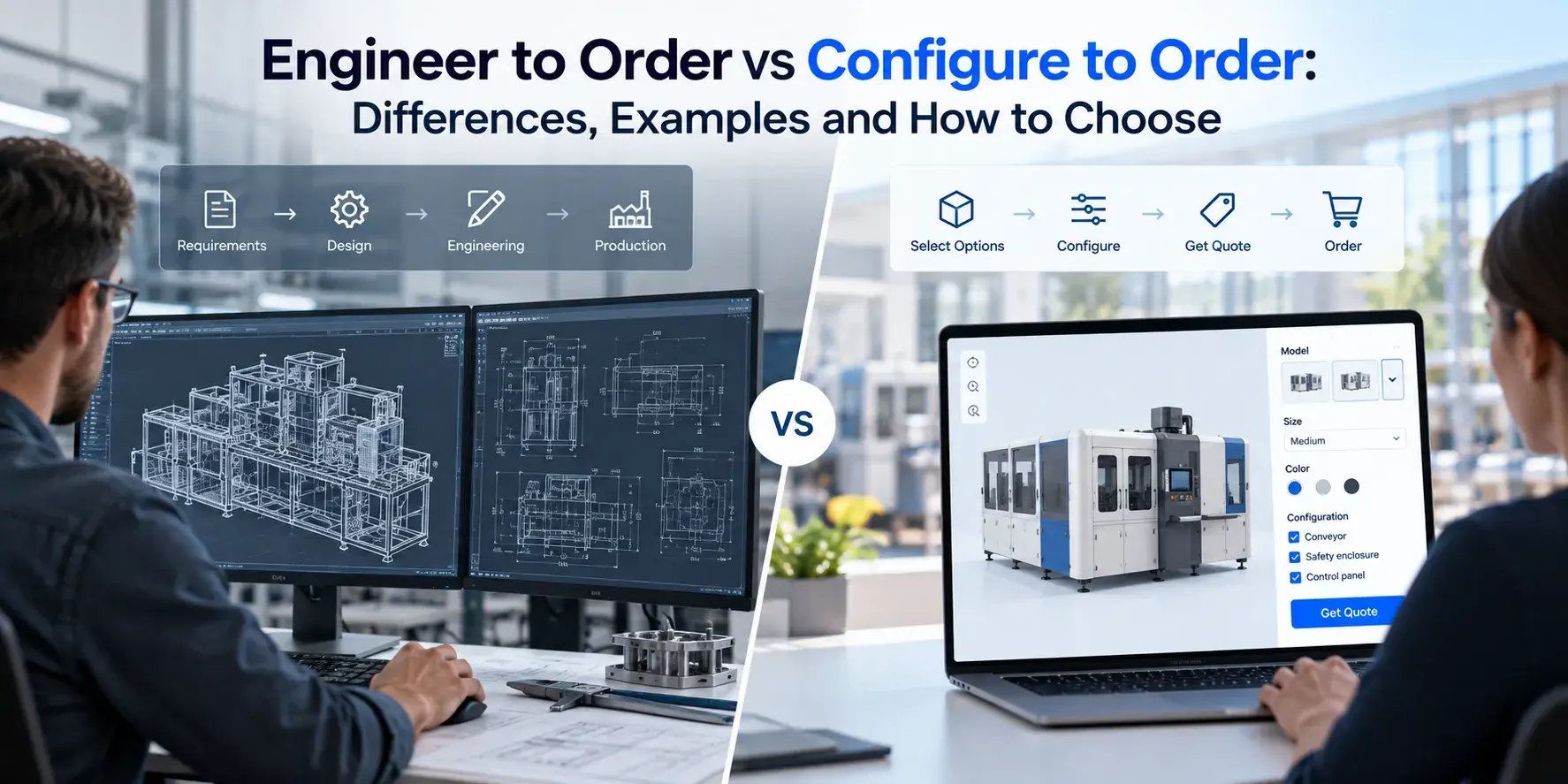
The difference between engineer to order and configure to order comes down to one question: does a new order need new engineering? In engineer to order (ETO), it does. Each order gets its own design work, drawings and bill of materials. In configure to order (CTO), it doesn't. The customer picks from options the engineers already designed and validated, and rules make sure every combination can be built.
Most manufacturers of complex products don't run purely one way or the other. The real decision is where to draw the line between the two, and that line moves as product lines mature.
What Is Engineer to Order (ETO)?
Engineer to order is a production model where design and engineering start after the customer places the order. Requirements come in, engineers produce a unique design, the bill of materials and routing are created for that one order, and only then does procurement and production begin.
Typical ETO products include custom industrial machinery, process plants, cranes, architectural glazing systems and commercial interior fit-outs. These are products where the customer's site, load or regulation make every order genuinely different.
ETO wins deals that standard products can't. The cost is time and risk. Quoting is slow because someone has to estimate work that hasn't been designed yet. Lead times are long because engineering sits on the critical path. And each new design carries a fresh chance of errors that only show up on the shop floor.
What Is Configure to Order (CTO)?
Configure to order is a model where the product is built from predefined components and options, combined according to rules. The engineering happens once, upfront, when the product family is designed. After that, each order is a configuration: a valid combination of dimensions, materials, modules and accessories.
A configurable office chair, a window with chosen size, glazing and color, or a pump unit selected from a range of motors and housings are all CTO products. The customer gets a product that feels tailored, but the factory builds it from known parts with a known process.
What makes CTO work is the rule set behind it. Which options are compatible, which dimensions are allowed, how a choice affects price and the bill of materials. That logic usually lives in a configurator or CPQ system. If you're new to the term, our guide to CPQ software covers how configure, price, quote tools handle it.
Engineer to Order vs Configure to Order: Key Differences
The two models differ in nearly every part of the order process, from the first quote to the final bill of materials.
| Engineer to Order (ETO) | Configure to Order (CTO) |
|---|
| When engineering happens | After each order | Once, when the product family is designed |
| Customer choice | Open-ended, based on requirements | Within predefined options and rules |
| Quoting | Estimated by engineers or sales engineers, often days or weeks | Generated from rules, often in minutes |
| Bill of materials | Created new for each order | Generated automatically from the configuration |
| Lead time | Long, engineering is on the critical path | Shorter and more predictable |
| Error risk | Higher, every design is new | Lower, combinations are validated in advance |
| Scalability | Limited by engineering capacity | Scales with sales volume |
The scalability row is the one that usually drives the decision. An ETO business can only take as many orders as its engineering team can process. A CTO business can let dealers, sales reps or customers configure orders themselves.
Where CTO and ETO Sit Among MTS, ATO and MTO
ETO and CTO are two points on a wider scale of manufacturing strategies, ordered by how much work happens before the customer orders.
Make to stock (MTS) builds finished goods in advance and ships from inventory. Assemble to order (ATO) stocks components and assembles them after the order arrives. Make to order (MTO) produces an existing design only once an order comes in. Configure to order (CTO) lets the customer choose from options and builds that specific configuration. Engineer to order (ETO) designs the product itself after the order.
CTO and ATO overlap heavily, and many companies use the terms loosely. The useful distinction: ATO is about inventory strategy (components are ready, assembly waits for the order), while CTO is about the product logic (the customer chooses, and rules decide what's valid). A configurable product can be built with ATO, MTO or a mix.
Examples by Industry
Windows and doors. Most residential orders are CTO. Width, height, frame material, glazing, color and hardware come from a defined range, and rules block combinations that won't pass structural or thermal limits. Oversized units, special shapes and curtain wall projects move into ETO. We look at how manufacturers handle this split in our article on window and door configurators for complex product sales.
Furniture. Modular sofas, office desking systems and kitchen cabinet ranges are classic CTO: fixed modules, finishes and dimensions in set increments. Built-in joinery for a specific room or a hotel fit-out with custom pieces is ETO.
Industrial equipment. Pumps, compressors, conveyors and electrical cabinets are often sold as configurable product lines, with motor sizes, materials and accessories chosen from a catalog. A complete production line designed for one plant is ETO, though it may be assembled largely from CTO modules.
The pattern repeats across industries. The standard range is configured. The edge of the range is engineered.
How to Choose Between ETO and CTO
Start with your order history, not your product catalog. Pull the last 12 months of orders and sort them by how much engineering each one needed. Most manufacturers find that a large share of "custom" orders were variations on a handful of designs: different sizes, materials or options, but the same underlying product.
Four factors decide which model fits a product line. Repetition is the first: if similar requests come in again and again, the engineering can be done once and reused. Variability is the second, meaning whether the variation can be described as a finite set of options and dimension ranges, or whether every customer brings a new problem. Volume matters too, since CTO pays off when there are enough orders to justify building the rules. The last factor is who sells. If dealers or distributors sell your product, they need a way to quote without calling your engineers, and that almost always means CTO.
ETO stays the right choice for genuinely one-off products, highly regulated projects with site-specific requirements and low-volume, high-value equipment where the engineering is part of what the customer pays for.
Hybrid Models: Configure to Order With Engineered Options
In practice, the most common setup is a hybrid. The core product is configurable, and a defined path exists for requests outside the rules.
A typical flow looks like this: the configurator covers the standard range and produces a quote and BOM automatically. When a customer needs something outside the limits, such as a larger size or a non-standard material, the configuration is flagged and routed to engineering. Engineering only works on the part that's new, starting from a valid base configuration instead of a blank page.
Over time, engineered requests that repeat get added to the configurator as new options. This is how product lines move from ETO toward CTO without a big-bang project: one recurring request at a time. Building the product as modules with clear interfaces makes this much easier, as we cover in modular product configurators: components, rules and pricing.
Signs It's Time to Move From ETO to CTO
Some symptoms show up again and again in businesses that have outgrown pure ETO:
- Engineers spend more time on routine variants than on genuinely new designs.
- Quotes take days because sales has to wait for engineering input on standard requests.
- The same design gets redrawn for different customers with small changes.
- Orders reach production with errors that come from manual copying between spreadsheets, drawings and the ERP.
- Dealers or sales reps can't quote without calling the factory.
- Lead times are set by the engineering backlog, not by production capacity.
If three or more of these sound familiar, at least part of your product range is probably ready for configure to order.
The Role of a Product Configurator in Each Model
In CTO, the configurator is the product. It holds the rules, calculates the price, generates the BOM and passes the order to ERP and production. Without it, CTO falls back to sales reps checking spreadsheets, which brings back the errors CTO was supposed to remove. The difference between a simple option picker and a full system is significant, and we break it down in product configurator tool vs system.
In ETO, the configurator plays a different role. It captures requirements in a structured way, gives a fast first estimate from the closest standard configuration, and lets the customer approve the direction before engineers spend hours on detailed design.
In both models, 3D visualization changes how customers decide. A buyer who can rotate the exact configuration, with the chosen size, finish and modules, doesn't need to imagine the result from a spec sheet. Fewer misunderstandings reach production, and approval cycles in ETO projects get shorter because everyone is looking at the same model.
Vivid 3D builds 3D product configurators that combine configuration rules with real-time 3D visualization, for manufacturers moving their standard range to configure to order while keeping a path for engineered requests. See how it works for manufacturing and industrial companies and for window and door manufacturers.
Choosing between engineer to order and configure to order is rarely a one-time decision. Configure what repeats, engineer what's truly new, and keep moving the line as your product range matures.
Frequently Asked Questions
What is the difference between engineer-to-order and make-to-order?
Make to order produces an existing, fully designed product once an order arrives. Engineer to order designs the product itself after the order, so engineering work, drawings and a new bill of materials are part of every order. MTO waits for the order to start production; ETO waits for it to start design.
What is the difference between CTO and ATO?
Assemble to order describes an inventory strategy: components are stocked in advance and assembled once the order comes in. Configure to order describes how the product is defined: the customer selects options, and rules determine which combinations are valid. The two often work together, with a configurable product assembled from stocked components.
What are the differences between MTO, MTS and ATO?
Make to stock builds finished products in advance and sells from inventory. Assemble to order keeps components in stock and assembles them after the order. Make to order starts production only when an order arrives. They differ in how much work is done before the customer commits, which trades inventory cost against lead time.
Can a company use both ETO and CTO?
Yes, and most manufacturers of complex products do. The standard range is sold as configure to order, while requests outside the configuration rules go to engineering. Recurring engineered requests are then added to the configurator as new options.