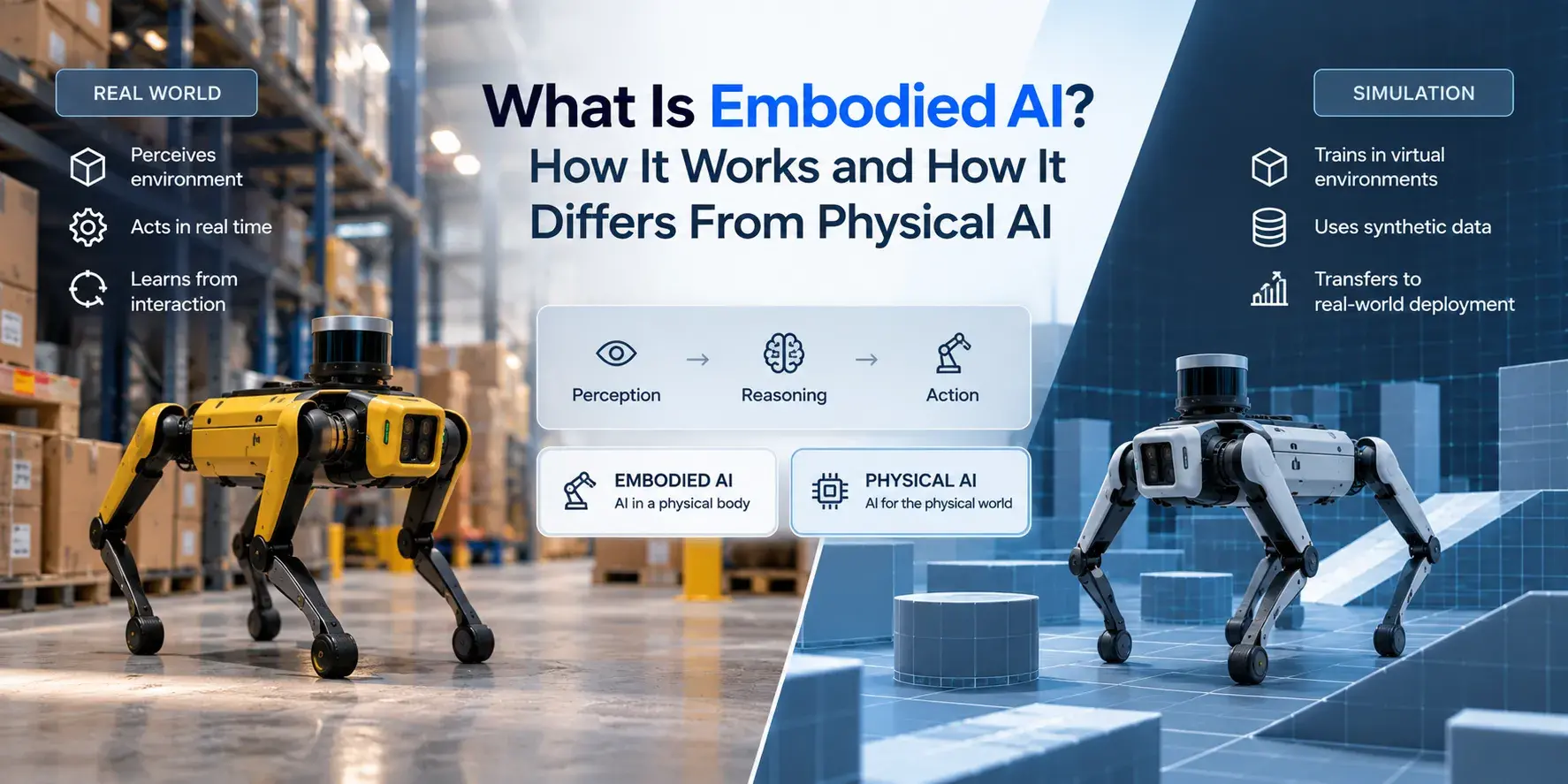
Embodied AI is artificial intelligence that has a body and learns by using it. Instead of processing text or images in isolation, an embodied AI system senses its surroundings, acts on them and learns from what happens next. A warehouse robot that figures out how to grip a box it has never seen, or a humanoid that adjusts its balance on an uneven floor, is embodied AI at work.
The term often appears next to physical AI, and the two get used as synonyms. They overlap, but they're not quite the same thing. Below we explain what embodied AI is, how it works, where it sits next to physical AI and robotics, and why training data is the hardest part of building it.
What Is Embodied AI?
"Embodied" means having a physical form. In AI, it describes systems whose intelligence is tied to a body that moves through and interacts with the world: a robot arm, a mobile robot, a humanoid, a vehicle.
The key idea isn't just that the AI has a body. It's that the body shapes what the AI learns. A language model learns from text someone else wrote. An embodied system learns from its own experience: it pushes an object and sees it slide, grips too hard and feels it crush, takes a step and registers that the ground was softer than expected. Perception and action form a loop, and that loop is where the learning happens.
The idea goes back decades in robotics research, where scientists argued that intelligence develops through interaction with the environment rather than through abstract reasoning alone. What changed recently is scale. Better simulation, cheaper sensors and large AI models have turned embodied AI from a research topic into products being tested in warehouses and factories.
How Embodied AI Works
Most embodied AI systems run the same loop, many times per second.
Perception
Sensors capture the state of the world: cameras for vision, depth sensors and LiDAR for geometry, force and tactile sensors for contact, joint encoders for the robot's own position. Perception models turn that raw data into something usable: where objects are, what they are, how they're oriented, whether the gripper is touching anything.
Reasoning and Planning
Given what it perceives and what it's trying to do, the system decides on its next action. In older robots, this was hand-written logic. In modern embodied AI, it's increasingly a learned policy: a neural network that maps observations to actions. Some recent systems use vision-language-action (VLA) models, such as Google DeepMind's RT-2, which take camera images and a plain-language instruction and output robot actions directly.
Action and Feedback
The system executes the action through motors and actuators, then observes the result. Did the object move as expected? Did the grip hold? That feedback flows back into perception, and over many trials, into learning. This closed loop is what separates embodied AI from a model that only analyzes data it's given.
Embodied AI vs Physical AI
Both terms describe AI that operates in the real world, and in practice most robots are both. The difference is in scope and emphasis.
Physical AI is the broader category. It covers any AI system that perceives, reasons about and acts on the physical world, including systems without a body of their own, such as AI that controls a factory line or a building's energy system. Embodied AI is narrower. It focuses on intelligence that lives in a body and is shaped by that body's interaction with the environment. We cover the wider category in our guide to what physical AI is.
| Physical AI | Embodied AI |
|---|
| Scope | Broad: any AI that senses and acts on the physical world | Narrower: AI with a body that learns through interaction |
| Needs its own body | Not always | Yes |
| Main focus | What the system does in the real world | How the body and its experience shape the intelligence |
| Where the term is common | Industry, especially around robotics platforms and simulation | Research, and increasingly robotics startups |
| Examples | Autonomous vehicles, humanoids, smart factory control, drones | Humanoids, learning robot arms, mobile robots |
A simple way to remember it: all embodied AI is physical AI, but not all physical AI is embodied.
Embodied AI vs Robotics and Traditional AI
Robotics is the hardware and engineering discipline: motors, joints, sensors, control systems. Embodied AI is the learned intelligence that runs on that hardware. A welding robot that repeats the same programmed path all day is robotics without embodied AI. Put a learned policy on the same arm that adapts to parts in slightly different positions, and it starts to qualify.
Traditional AI, sometimes called disembodied AI, works on data handed to it: text, images, spreadsheets. It never acts on the world or sees the consequences of its outputs. Embodied AI is a common answer to "is a robot an AI?" Some robots are just machines following scripts. The ones that perceive, decide and learn are AI systems with a body.
Examples of Embodied AI
Warehouses and logistics. Mobile robots and robot arms pick, sort and move goods in environments built for people. Agility Robotics' humanoid Digit, for example, moved into commercial work at GXO Logistics under a robots-as-a-service agreement, handling totes in a warehouse.
Manufacturing. Humanoids and learning arms are being tested on assembly and material handling tasks. Figure signed an agreement in 2024 to deploy its humanoid robots at BMW's plant in Spartanburg, South Carolina, starting with staged pilots.
Autonomous vehicles. Self-driving cars and delivery robots perceive traffic, predict what others will do and act in real time. They are embodied AI on wheels, even if few people call them that.
Homes and services. Robot vacuums were an early, simple form of embodied AI. Research labs are now training general household robots that fold laundry, load dishwashers and tidy rooms, tasks that are trivial for people and very hard for machines.
How Embodied AI Systems Are Trained
This is the hardest part. Language models learn from text scraped from the internet. There is no equivalent internet of robot experience. Every example of a robot gripping, walking or opening a door has to be produced somehow, and each source has tradeoffs.
Teleoperation means a human controls the robot remotely while the system records what happens. It produces realistic data, but it is slow and limited by how many operators and robots you have. Real-world trial and error lets the robot learn by doing, which is accurate but slow, and risky for both the robot and its surroundings.
Simulation runs thousands of virtual robots in parallel, with no hardware to break. It is the main way embodied AI policies get enough practice. The catch is the gap between simulation and reality: models trained in a simulator often perform worse on a real robot. Our article on the sim-to-real gap covers why that happens and how teams close it.
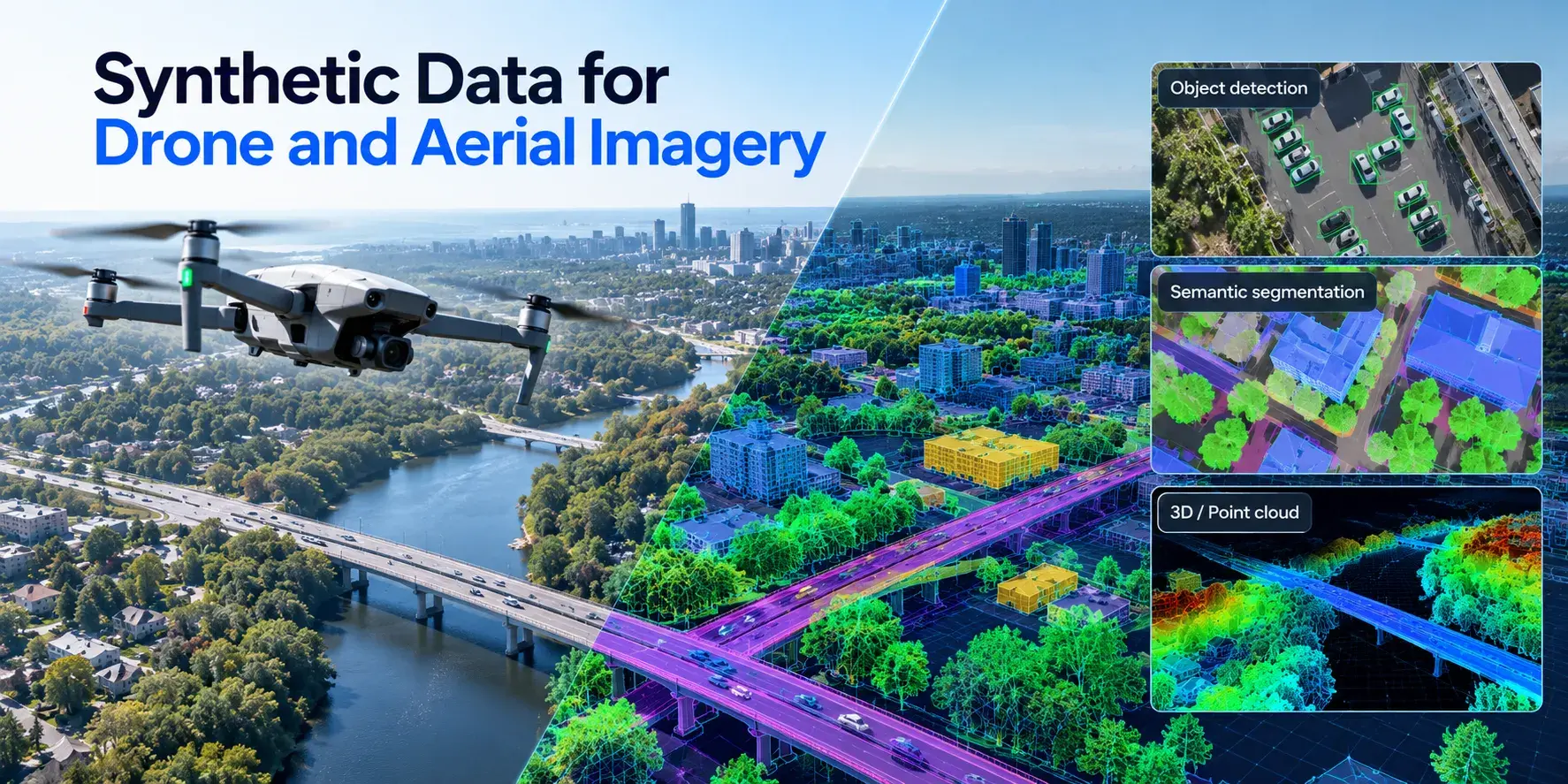
Synthetic data generated from 3D scenes trains the perception side: detecting objects, estimating their pose and segmenting scenes, with labels produced automatically and rare situations generated on demand. Most teams combine it with a smaller amount of real data, as we explain in synthetic data for robotics training.
Increasingly, teams also use world models, AI systems that learn to predict how scenes will change, as another way to give robots experience without real-world trials. We look at how they relate to physics-based simulation in world models need a physics teacher.
Challenges Holding Embodied AI Back
Data remains the biggest one. Covering the variety of objects, environments and situations a general-purpose robot will meet takes far more examples than any team can collect by hand.
Generalization is the second. A robot trained in one warehouse often struggles in another with different shelving, lighting and packaging. Contact-rich tasks, like handling cloth, cables or soft food, remain especially hard to model and to learn.
Then there are the physical limits: battery life, the cost of hardware, safety around people, and the need to make decisions in milliseconds on limited onboard compute. None of these are solved by a bigger model alone.
Vivid 3D works on the data side of this problem, building synthetic datasets from controlled 3D scenes for robotics and Physical AI teams training perception models. See how we support robotics and Physical AI infrastructure.
Embodied AI is where AI stops only describing the world and starts acting in it. The bodies are getting better quickly. The data to train them is what will decide how fast embodied AI moves from pilots to everyday work.
Frequently Asked Questions
What does embodied mean in AI?
It means the AI has a physical body, such as a robot, and that its intelligence develops through the body's interaction with the world. The system senses, acts and learns from the results, rather than only processing data it is given.
Is a robot an embodied AI?
Not always. A robot that follows a fixed program is a machine, not embodied AI. A robot that perceives its environment, makes decisions with learned models and improves from experience is an example of embodied AI.
Is embodied AI the same as physical AI?
They overlap but differ in scope. Physical AI covers any AI that senses and acts in the physical world, including systems without their own body. Embodied AI is the subset where intelligence lives in a body and is shaped by its interaction with the environment.
What is an example of embodied AI?
Humanoid robots tested in warehouses and factories, robot arms that learn to grasp unfamiliar objects, autonomous vehicles and household robots are all examples. What they share is a loop of perceiving, acting and learning from the results.
How is embodied AI trained?
Through a mix of teleoperation, real-world trial and error, simulation and synthetic data. Simulation and synthetic data provide scale and rare situations, while real-world data keeps the models grounded in how sensors and physics actually behave.