World models are the most exciting idea in physical AI right now. Feed one enough video of the world and it learns to imagine what happens next, predicting how a scene unfolds the way a language model predicts the next word. The promise is a robot that can picture the consequences of its own actions before it moves. It is a genuinely powerful shift, and it is drawing enormous investment.
But imagination without grounding is just confident guessing. A world model trained only on observation learns what tends to look right, not what is physically true. It will happily generate a video where a stacked box hovers for a frame, a poured liquid defies gravity, or a gripper passes through the object it was supposed to hold. On a screen these slips are charming. On a factory floor they are the difference between a working cell and a scrapped part. The next wave of physical AI will not be won by the model with the most imagination. It will be won by the one that learned physics from a good teacher.
What world models get right, and where they drift
The strength of a world model is generalization. Because it learns from vast, messy, real footage, it picks up patterns no engineer could ever script by hand. How a crowd flows around an obstacle, how fabric drapes, how a pedestrian hesitates at a curb. That behavioral richness is exactly what rigid, rule-based systems have always struggled to capture, and it is why world models feel like such a leap.
The weakness is the flip side of the same coin. Learning from observation means the model absorbs correlation, not causation. It knows what usually follows, so it produces futures that are plausible rather than correct. When a scene drifts outside what the model has seen, or when the physics gets subtle, the prediction degrades quietly. Nothing flags the error. The frame still looks convincing. This is the hallucination problem, and in the physical world a convincing hallucination is more dangerous than an obvious one, because a downstream planner will trust it.
Simulation is the physics teacher
This is where simulation earns its place, and it is a role the industry keeps underrating. A 3D physics simulator does not guess. It computes the future from engineered rules: rigid body dynamics, friction, contact forces, material behavior, light transport. Every frame it produces is consistent with a defined model of how the world works, and it comes with perfect ground truth attached, down to the exact pose and depth of every object in the scene.
That makes simulation the ideal teacher for a world model. Where observation gives breadth, simulation gives correctness. You can generate the rare and dangerous situations a model would almost never witness in real footage, a near-collision, a failed grasp, a load shifting past its limit, and you can produce them by the thousand, labeled and repeatable. A world model trained or grounded on that material learns not just what looks right but what actually holds up, because it was corrected against physics every step of the way. Think of it as a curriculum. Real data teaches variety. Simulation teaches the rules, and keeps the student honest when its imagination starts to wander.
The pairing also closes the loop in the other direction. A world model can propose a wide range of futures fast, and simulation can check the ones that matter against real dynamics before anything reaches hardware. Breadth proposes, physics verifies. Neither approach is complete on its own, which is precisely why the strongest teams run both.
The classroom is synthetic
Building that curriculum at scale is its own discipline, and it is where a lot of physical AI programs stall. Collecting real-world interaction data is slow, expensive, and often unsafe, especially for the edge cases that matter most. You cannot crash a forklift a thousand times to teach a model what a near-miss looks like. Simulation-generated synthetic data solves this by manufacturing the exact scenarios you need, physically grounded and fully labeled, without staging a single real event.
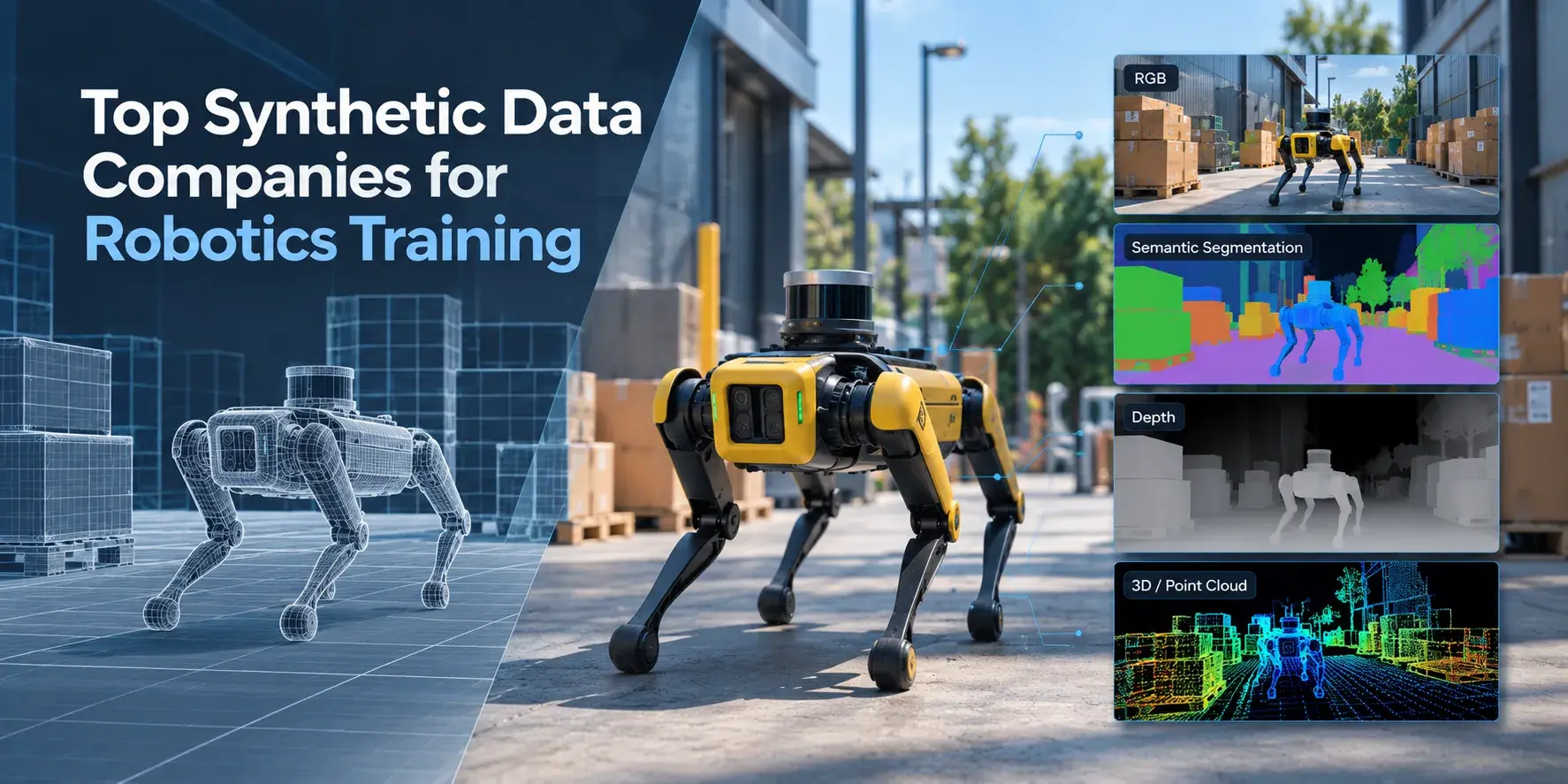
This is the problem Vivid3D works on. Its simulation pipeline produces physically accurate 3D scenes with automatic annotations, the kind of grounded, controllable data that trains perception and policy models and gives world models something reliable to learn from. Teams control which edge cases, lighting conditions, and object variations show up in the training set, then let learned models generalize on top. The result is a robotics and vision stack where the imaginative layer and the physics layer reinforce each other instead of drifting apart. The same logic runs through how synthetic data is used for robotics training and, more broadly, across the infrastructure behind robotics and physical AI.
What this means for the next wave
The headlines will keep celebrating bigger world models, and they should, because the imaginative leap is real. But the systems that actually make it onto factory floors, into warehouses, and behind the wheel will be the ones that treated physics as a teacher rather than an afterthought. In manufacturing, that means robots that can be trusted to handle contact-rich tasks because they were trained against real dynamics, not just plausible video. In autonomous logistics, it means fleets that rehearsed their rare failures in simulation long before meeting them on the road.
The lesson underneath all of it is simple. A model that only imagines will eventually imagine something that cannot happen, and act on it. Grounding that imagination in simulated physics is not a constraint on the technology. It is what turns a compelling demo into a system you can deploy. World models are ready to learn. The next wave of physical AI depends on giving them a teacher worth learning from.