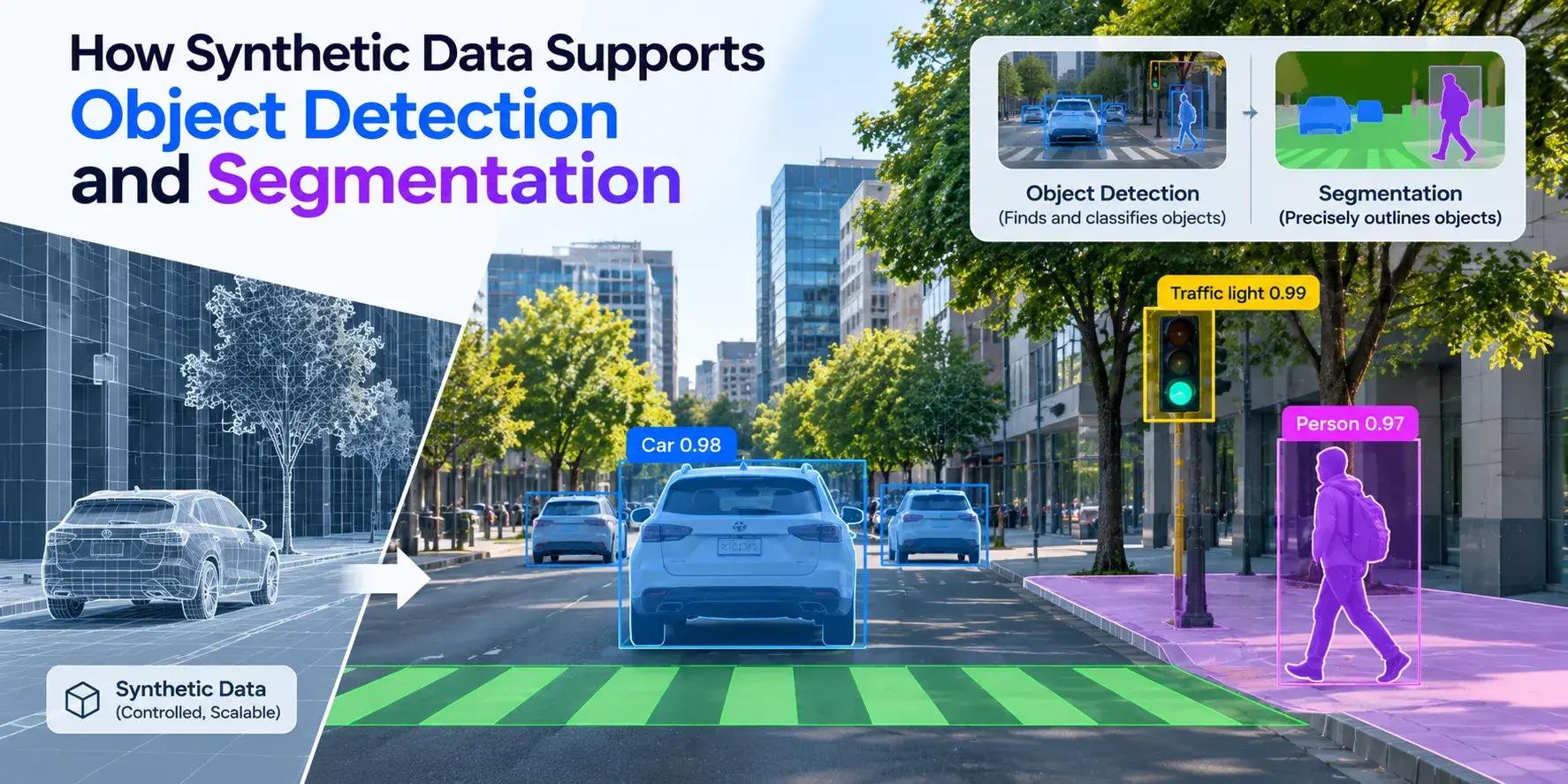
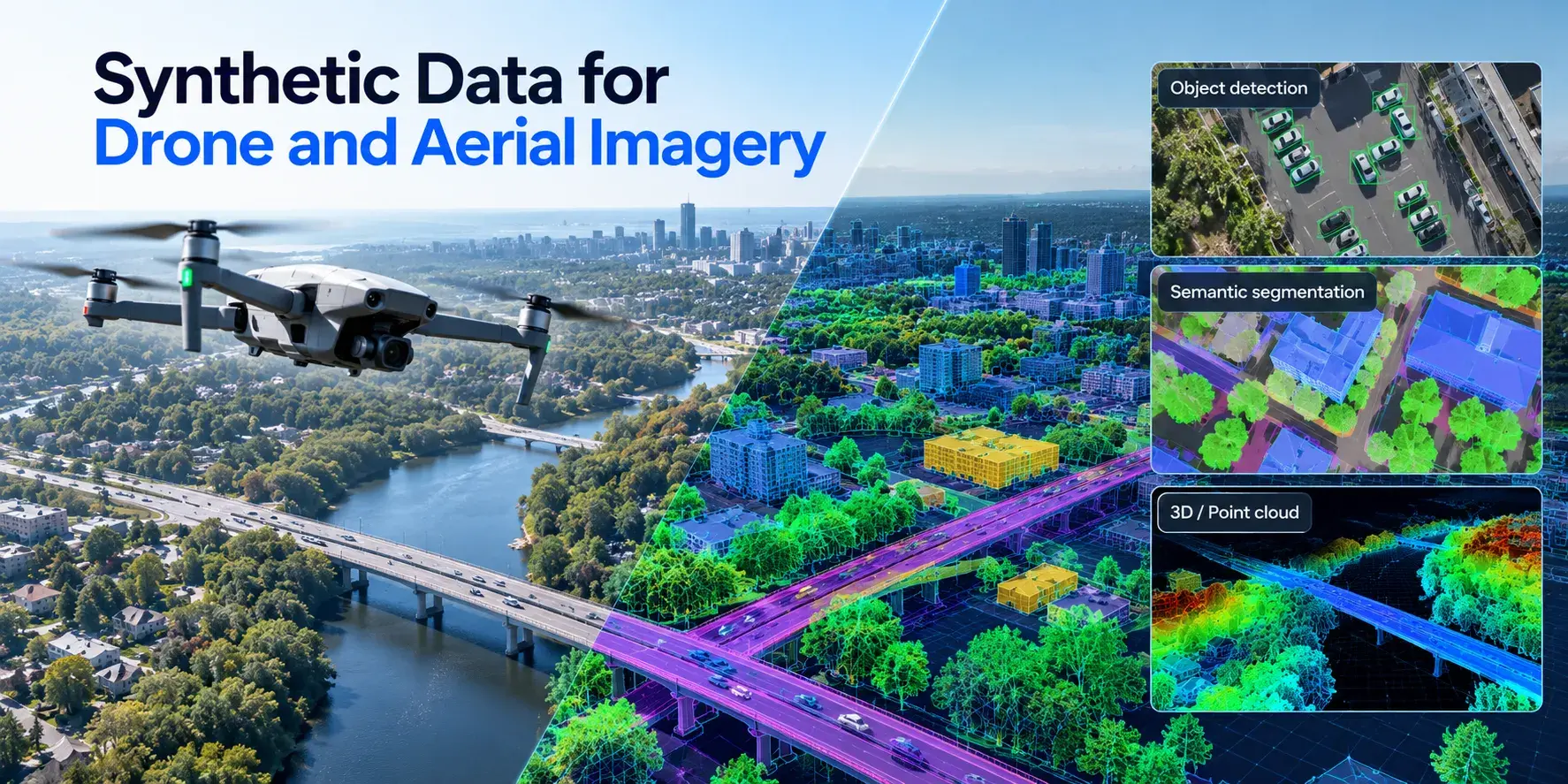
Synthetic data for object detection and segmentation works because every image arrives already labeled. When a scene is rendered from 3D, the engine knows where each object sits, so bounding boxes, pixel masks and depth come out of the pipeline at no extra annotation cost. Detection gains from that. Segmentation gains far more, since masks are the most expensive labels to draw by hand.
Below we break down what each task gets from synthetic images, the three main ways to generate them, how much real data you still need, and where the approach falls short.
What synthetic data gives a detection or segmentation model
Synthetic data is artificially generated imagery, usually rendered from 3D scenes, that comes with exact ground truth for every object in the frame. For an object detector, that means boxes and class labels. For a segmentation model, it means per-pixel masks. Both can be produced in volumes and variations that real capture can't match, including rare objects, unusual angles and conditions that are dangerous or slow to photograph.
The value differs by task. A detector needs to learn "something of class X is roughly here." A segmentation model has to learn the exact outline of that something, pixel by pixel. That gap in precision is also a gap in labeling cost, and it decides where synthetic data pays off fastest. We covered the general case in why synthetic data is used to train computer vision; this article stays with these two tasks.
Labels you get for free: boxes, masks and depth
Bounding boxes for object detection
In a rendered scene, a bounding box is simply the projection of the object's geometry onto the camera plane. Occluded and truncated objects can be flagged automatically, because the renderer knows how much of each object is visible. Human annotators often disagree on those edge cases. A renderer doesn't.
Boxes can be exported in whatever format your training code expects: COCO JSON, YOLO text files or Pascal VOC XML.
Semantic, instance and panoptic masks
Segmentation comes in three flavors. Semantic masks assign a class to every pixel ("hull," "water," "sky"). Instance masks separate individual objects of the same class, so two boats get two different IDs. Panoptic masks combine both. A rendering pipeline can write all three in the same pass, because each pixel already carries the ID of the object that produced it.
Depth maps, surface normals and 3D keypoints can come out of the same pass. Some teams use them as auxiliary training signals; others ignore them until they need them.
Why pixel-level labels change the cost math
Drawing a polygon around an object takes far longer than drawing a box. The team behind the COCO dataset reported about 22 worker hours per 1,000 instance segmentations, and that was with a purpose-built annotation interface (Lin et al., Microsoft COCO). Masks also degrade at boundaries: thin structures like masts, cables or robot grippers are where human labels get sloppy.
So if your project needs segmentation, synthetic data removes the most expensive step in the whole data pipeline. For detection only, the saving is real but smaller. For a deeper look at labeling workflows, see our guide to synthetic data in computer vision annotation.
How synthetic images for object detection are generated
Cut-and-paste compositing
The simplest method: cut object images out of their backgrounds and paste them onto new ones at random positions, scales and rotations. Labels follow from where you pasted. It's cheap and fast to set up with a few lines of Python. The weakness is physical plausibility. Lighting, shadows and perspective rarely match the background, and models can learn to spot paste edges instead of the object.
Rendering from 3D scenes
Here the objects, environment, lights and camera are all modeled in 3D, then rendered. You control pose, material, weather, time of day, sensor noise and occlusion as parameters. Early work already showed the gap with simpler tricks: rendered training images for drone, plane and car detection outperformed perturbed copies of real images (Rozantsev et al.). The cost is upfront: you need good 3D assets and a scene pipeline. At Vivid 3D this is the core of the synthetic data platform for computer vision, built on a library of simulation-ready assets.
Diffusion-generated images
Generative models can now produce photoreal images from text or from a rough layout. The catch is labels. A diffusion model doesn't know where the object's edges are, so masks have to be inferred afterwards (by attention maps or a separate segmentation model), and those inferred masks inherit errors. Recent work composes generated object segments into new scenes and reports gains on COCO and LVIS, especially for rare classes. Diffusion is strong for appearance variety; rendering is stronger when labels must be exact.
Domain randomization and the sim-to-real gap
A model trained only on clean renders tends to stumble on real photos. Textures are too uniform, edges too sharp, noise patterns wrong. Domain randomization attacks this by varying everything that shouldn't matter (textures, lighting, backgrounds, camera exposure, distractor objects) so widely that real images look like just one more variation.
For segmentation, one detail matters more than for detection: boundary realism. Supervisely's crack segmentation experiments found that smoothing and texturing object edges, plus style transfer, moved a synthetic-only model close to one trained on real images. Boxes forgive blurry edges. Masks don't. We go deeper into the causes and fixes in our article on the sim-to-real gap.
How much synthetic data to mix with real data
Most published results point the same way: synthetic data works best next to real data, not instead of it. Two common patterns:
- Pretrain on a large synthetic set, then fine-tune on a small real set. This is the usual choice when real images are scarce or expensive to label.
- Train on a mixed set from the start, with synthetic images filling the gaps in real data: rare classes, edge cases, conditions you never captured.
More synthetic isn't always better. A study on randomly piled objects found average precision dropped once synthetic images outnumbered real ones, mostly at strict IoU thresholds, which is exactly where segmentation quality is measured. On the other side, a SIBGRAPI 2020 paper trained Mask R-CNN mostly on rendered machinery scenes and reached 85.7% mAP for detection and 84.8% for segmentation on real test images (SIBGRAPI 2020).
The ratio that works depends on the domain, so treat it as something to tune against a real validation set. For a full comparison of the two data sources, read synthetic data vs real data.
Where synthetic data struggles in detection and segmentation
Small objects are the first problem. A boat that covers 20 pixels in a real frame is mostly sensor noise and compression artifacts. If the renderer doesn't reproduce that noise, the detector learns a clean version that never appears in production.
Sensor-specific effects come next: lens distortion, motion blur, rolling shutter, wide-angle cameras in tight spaces. These have to be modeled on purpose. A smart vending machine study, for example, had to add wide-angle distortion before its synthetic data helped.
Then there's asset quality. Detection tolerates simplified geometry. Segmentation of thin parts (ropes, railings, cables) does not, and a low-poly asset produces masks the real object never matches. The same is true for materials: a hull with no wear, rust or water reflections teaches the model a version of the object that doesn't exist.
Finally, validation. If you only check scores on a synthetic test split, you'll see numbers that won't hold. Always hold out real images for evaluation. Our checklist on how to validate synthetic data quality before model training covers this step.
Example: vessel detection from synthetic maritime scenes
Maritime detection shows why the approach exists. Real footage of vessels is unbalanced: lots of open water, few rare ship types, almost no examples in fog, glare or heavy swell. Labeling it is slow, and instance masks of hulls against moving water are hard to draw consistently.
A rendered maritime scene flips that. You place vessel models of each class, set sea state, weather, sun angle and camera height, then generate thousands of frames with boxes and masks attached. Rare classes get as many examples as common ones. Hard cases such as partial occlusion by waves or vessels at the horizon line can be generated on demand instead of waited for. Our guide on generating edge cases for computer vision models explains how to plan those scenarios.
Getting started with a synthetic dataset
Start from the label you need. If it's boxes only and you have a decent real dataset, use synthetic images to fill rare classes and edge cases. If it's masks, synthetic data can carry most of the training volume, with a smaller real set for fine-tuning and evaluation. In both cases, keep a real validation set and tune the mix against it.
Vivid 3D generates labeled synthetic datasets for detection and segmentation from simulation-ready 3D scenes. See how it works on the synthetic data for computer vision page, or book a demo to scope a dataset for your object detection or segmentation model.
Frequently Asked Questions
Does synthetic data work for object detection?
Yes, in most published results it improves detection accuracy, especially when it supplements a real training set rather than replacing it. Gains are largest for rare classes and conditions that are hard to capture.
Can you train a segmentation model only on synthetic data?
It's possible, and some experiments get close to real-data performance with careful boundary realism and style transfer. In practice, fine-tuning on a small real set and evaluating on real images gives more reliable results.
How many synthetic images do you need?
There's no fixed number. Teams often start with a few thousand images per class, then increase volume and variation where validation on real data shows weak spots. Past a certain ratio, adding synthetic images can lower precision, so measure as you go.
Is synthetic data better than data augmentation?
They solve different problems. Augmentation varies images you already have (crops, flips, color shifts). Synthetic data creates new scenes, poses and objects you never captured. Most pipelines use both.